Keep Us Connected
While the life of a writer can often be solitary, we must find moments to keep us connected. Throughout my journey, I have had the opportunity to be part of different writing communities, but the most recent is among a group of four other authors.

During the uncertainty of the last few years, this group has been a refuge and a way to stay tethered despite isolation, countless revisions, and the oddly cathartic pressure of completing a post-pandemic story while living in a pandemic.
For any writers who may not know the benefits of a writing group, I am excited to share my latest remote meeting. I will be reading from Chapter Three of my YA speculative novel, DREAM CATCHERS. Afterward, my fantastic group of fellow authors will be sharing their feedback.

Once the meeting adjourns, what happens next? I take my feedback and add it to the applicable chapter card on my book’s Trello board. I like to include the date and then break down the feedback by the author who gave it to me. That way, if I have any questions in the future during the revision and editing process, I can go back for clarifications.

For myself, organizing the writing process from brainstorming to drafting to developmental edits, line edits, beta reads, and more works best on Trello.
For those wondering how to find a writing group, how to know when that group is the right fit, and the pros and cons of getting consistent feedback and readership while you focus on a work-in-progress, rest assured I will be diving into this in the future!
Don’t forget to like and subscribe. And remember, no matter where the day takes you, dream big!

As a Victory
It’s been one week since I attended the Women’s March in Buffalo, NY, and I’m excited to share that experience here. Before I talk about the actual day of the march, I did just want to travel back in time a few weeks to the moment I heard about this event.

On September 14th, my sister sent the link for the Women’s March, and I knew we absolutely needed to attend. However, when looking closer at the details, we did notice it was within the same time frame as my cousin’s wedding.
Despite the challenge of this busy day and the realization that yes, everything does always fall on the same day, we decided we would go to the event first and then make our way to the wedding reception after. At this point, we did have all the logistical details worked out, but we knew we would have ample days to come up with a game plan.
Per the information I had already read, it looked like there were open spots for speakers at this event. As someone incredibly passionate about women’s rights and someone in the unique position of a new collective all to do with womanhood, I knew it was important for me to volunteer. I registered for the event and emailed the organizer to let her know I wanted to speak. At this time, I considered reading a poem, thinking about the words I’d already written and the ones I could write.
After sending that email, I also realized that I wanted to create some merch inspired by the event. I had already launched a few pieces inspired by The Elpis Pages. I went to work that night creating a few designs.

The days started to pass. I ordered my t-shirt, which I discussed in my Editor Diaries. It has a quote by the incomparable RBG on the front and Bans Off Our Bodies on the back. A few of the other designs incorporated this same slogan, some with the Elpis logo and one specifically inspired by The Handmaid’s Tale, which simply reads “OfHerself.” These are still available for purchase.
I also looked back through previously written poetry in the hopes I could find something to read at the event. On September 20, 2020, I wrote a poem entitled “All the Things You Could Miss At the End of This.” Today the poem is still unfinished and unpublished, but I have high hopes for its future. I wrote this poem two days after Ruth Bader Ginsburg’s passing. It was something that sat in my mind until I put the words on the page. And it was inspired by a Twitter thread in which the line “May her memory be a revolution” was broken down and the Jewish traditions explored. I was fascinated and proud as a woman for the legacy Ruth was leaving behind, but also sad and scared for a world without her in it.
That poem also goes on to explore a few key women in my life. But it all came back to Ruth. I still love these stanzas:
You don’t know how to write this part. But you bellow the words of a prayer typed out to be mindful of character counts: May her memory be a revolution. The leaving remains in everything. Every fact. This season must go. She is gone.
And you cling to someone else’s poiesis in regards to the pain of seeing empty places at the dinner table. They expound on Jewish traditions you commit to the page because you fear those, too, will disappear. She was held on earth until the end of this year because she was needed. It is how they speak of her passing on a holy day, effusing the sacred with beauty about the revolutionary ramification of womanhood, of truth. Of Her.
But this poem didn’t feel quite right. I penned other bits and lines. I wrote:
When I was young, I was scared of being soft. And I said, yes, he’s nice though I was scared. And later, I couldn’t walk to the car and my hair was long and I thought that was the problem.
This all came from one of my most terrifying memories. In which I was harassed by a male employee and then questioned by the owner. He asked to see if I’d been flirting with said employee and thus “asking for” that kind of unwanted attention. My hair was long then and I was nice, maybe too nice. I also wrote:
I liked the weird women in Macbeth. I knew them for who they were: poets with guts filled with feelings. They might’ve clasped car keys in fingers as a talisman. And I hold my palms to the women before: Circe, Hecate, Elpis.
Another line played over and over in my mind:
And I cried to my mother, telling her I didn’t ask for this. And she explained I was born to hold a universe, but of which she was unclear.
There were so many things to write or reread that had to do with womanhood, but they didn’t feel like enough.

I moved on to other preparations for the event. I designed two posters to be printed. One for myself and one for my sister. I also created postcards with information about The Elpis Pages to be handed out prior to our march to city hall. I got a little crafty with the posters, mounting them on foam board and adding a handle.

And then on Tuesday September 28th, just a few days before the march, I couldn’t keep the line: “half of a whole is still less than” from echoing in my head. This is not uncommon, as I am the type that hears all thoughts as narration and usually with lines of dialogue or poetry, they won’t cease until they’ve been written. What can I say? My writerly brain is persistent.
I didn’t think this line could be the opening, so I back tracked, thinking about how much I always struggled with math back in school, specifically fractions. And from there, my speech spilled out in a torrent. I knew its title, “Sometimes All We Have is Hope,” since I’d been using that as the tagline for The Elpis Pages. It is something that continues to carry me through and remind me why this project is so important.
I finished my speech and sent it to my friends. I practiced reading it and recorded it over a voice memo. Even on the day of the event, I took the printed version of my speech to the backyard to practice reading over noise pollution, projecting like I’d learned to do back in my theater kid days.

I was ready to read, but needed to get ready for the day. I put on my RBG shirt, left to get my hair done for the wedding later, and focused on the excited energy I had for the march. My sister arrived, we grabbed our signs, and our dad dropped us off at Prospect Park, which was the location we would be meeting before beginning the march at 2PM.
When we arrived, there were so many women and men already gathering. Many were in purple shirts, as this year’s colors were purple and cream. We snapped some photos early on and I handed out my postcards for The Elpis Pages. Everyone was so kind as I did so and there was a palpable energy surrounding the park as we read each other’s signs and shirts.

I must say, I’d planned to take more photos and videos, but I was drawn into the moment and am mostly left with memories now. A few favorite posters included: Ruth Sent Us, Without Hermione, Harry would’ve died in Book One, We Are Not Ovary-Acting, etc. Everyone had taken the time and effort to create messages filled with rage, confusion, and alas, hope. And before long, we were marching through the streets of Buffalo on our way to City Hall.

We chanted: "Bans Off Our Bodies, Who’s Streets, Our Streets, Hell No Roe Won’t Go, and my favorite: Who Sent Us? Ruth Sent Us. Each step during this walk made me feel empowered and heard, poster raised high above my head. There were people there who’d marched before and others new to the experience like myself. But all came together to speak on behalf of the importance of women’s rights.

Once we arrived at City Hall, my sister and I moved closer to the front, as I knew I would be speaking, though I wasn’t sure when. Unfortunately, we had to leave by 3:30 to ensure we could make it to the wedding reception, but we had the chance to listen to wonderful and inspiring and important words spoken from different women.
And then it was my turn to speak.

I folded the speech in half to keep it from blowing free from my grip. Downtown Buffalo is notoriously windy. I took a deep breath and began. I supposed what I wasn’t expecting were the cheers from the crowd. But I took that in stride, even managing the loud traffic that occurred during my reading.
With this speech, I felt every word in my bones.
I will also be including my speech in full with my Letter From the Editor in The Elpis Pages once it’s published this December.
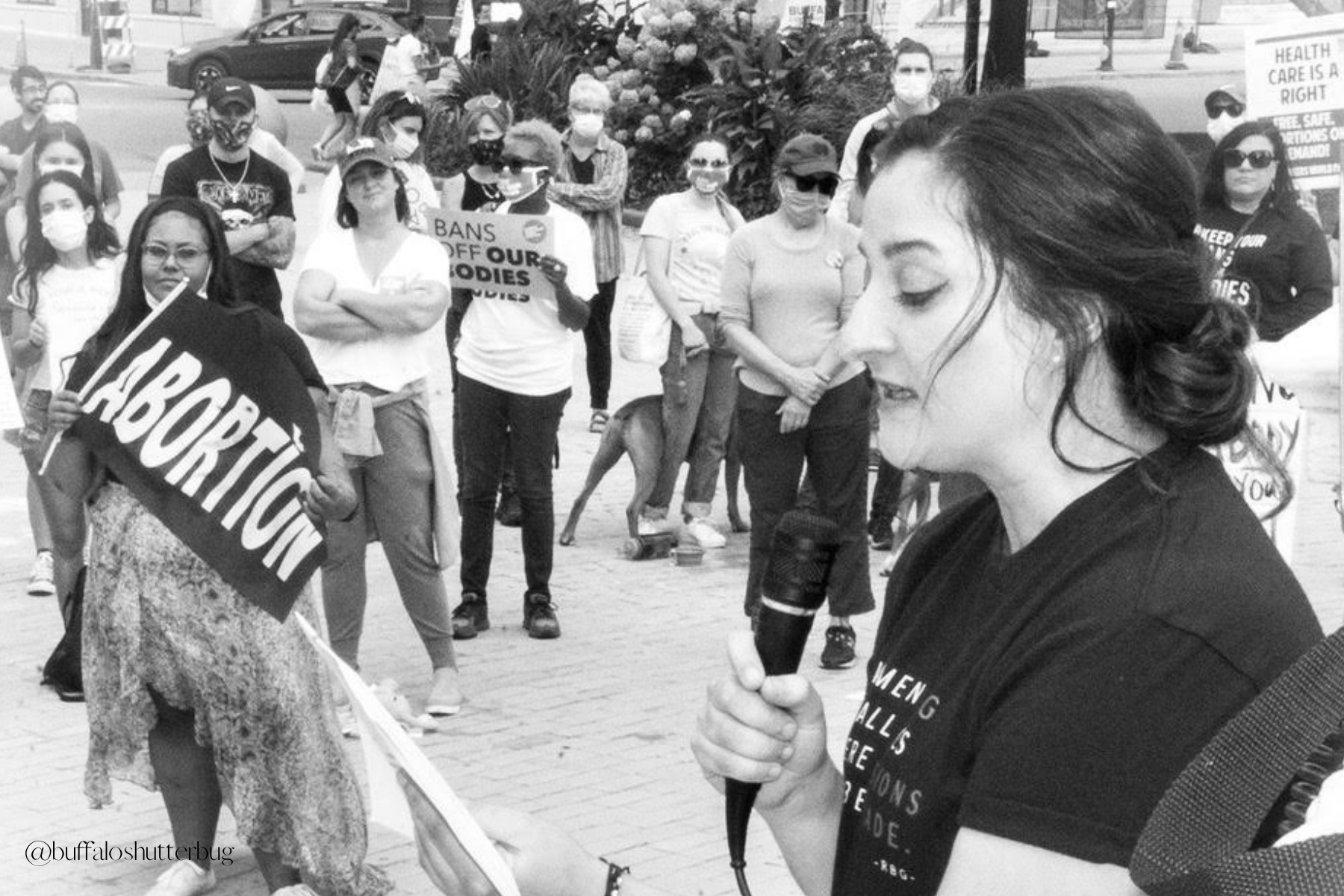
And just like that, it was time to leave. To prepare for a different kind of celebration. But I held the memories with me through the lengthy car ride, trying to share as much about the experience with friends and family at the wedding as I could. By this time, my mom had already shared my video, and it was heartwarming to hear those reactions from some of those I love most.
As I continue to champion women and their rights, putting together this collective to support the Planned Parenthood Action Fund, offering a safe haven and platform for self-identifying women to share their words on womanhood, I will not forget this day and everything it gave me and our nation.

Just three days after a historic gathering in over 650 cities nationwide, U.S. Judge Pitman issued a stay of SB8, declaring that the Court “will not sanction one more day of this offensive deprivation of such an important right…” In this I find the reminder that each step, no matter how small, must be taken as a victory. I’m reminded that we all have the power to speak up and offer our voices to the collective we in this nation and say we do not accept this. We deserve better. However, there is so much more work to be done, and I’m ready to continue to add my voice and my words to this fight for women’s rights.
I would like to thank everyone who showed up throughout the nation to march for women. I’d like to thank our organizers and give a specific shoutout to Anya Kester and Glenn Murray for sharing many of these photos from the day.
Don’t forget to like and subscribe. And remember, no matter where the day takes you, dream big!

This Spooky Season
October is my favorite month and I absolutely love spooky season, which makes setting up my planner extra special. This is the third year in a row that I have used Archer & Olive’s Undated Planner. Though I am not using watercolors or paint pens, I do love the quality of paper and overall construction of this planner.

1.) Select pen color
The first thing I do is select the pen color to be used for the entire month. October was easy. I knew I would be utilizing spooky accents throughout the spread so I selected a black pen from my extensive collection. Fun fact, I only use Papermate Flair Tip Pens.
2.) Select Washi Tape
After I have my pen color, I go through my washi tape, choosing patterns that correlate to the monthly color. I always pull more than I need. During the last few months, it’s become a tradition that my mom selects the 6-7 washi tapes that will be used for the spread. This month was no different.

Once I have the tapes selected. I start with the monthly calendar page. I usually select a wider washi tape for both the monthly calendar page and the dotted grid page, which I use for memory keeping.
To make the application process as easy as possible, I use binder clips to hold down my pages. I do a rough size match against the page before making any cuts. And then you’ll see that I am applying horizontally to the top and bottom of this calendar page. I usually will make the tape just a smidge longer than necessary, so once both pieces of tape have been adhered, I go back and snip any access from the edges.
And then I repeat this process for each of the pages that month. At this point, the spread remains undated. I have made the mistake in the past of dating everything and then applying the washi tape over top of those details.
3.) Fill in Dates
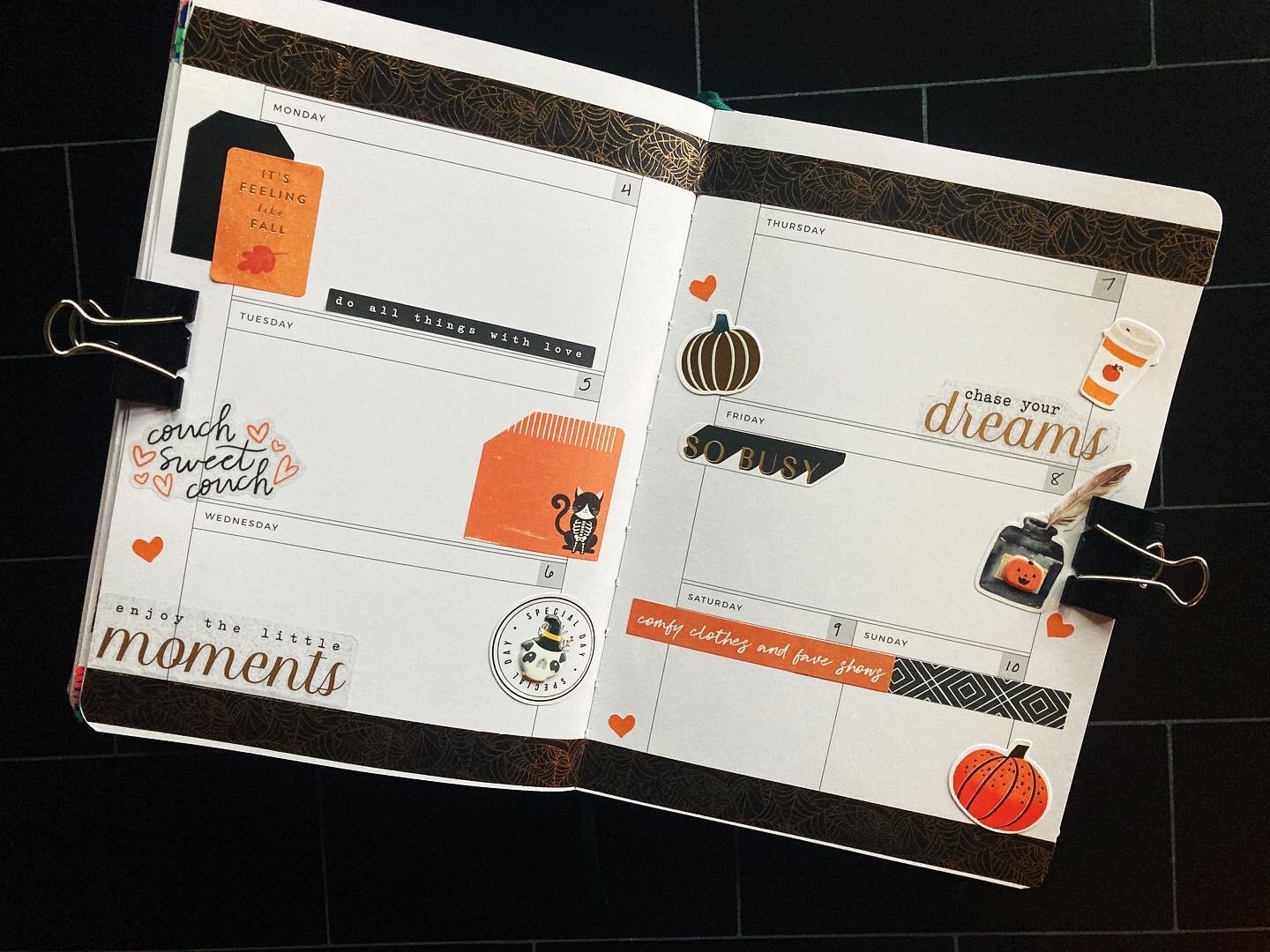
Now that the washi tape has been applied, I go through and add all the dates to the monthly page. I also begin my week on Monday. This is actually one of the biggest reasons why I started using an undated planner. A big pet peeve of mine are weekly and monthly pages that begin on Sunday. I then go page by page, adding the dates.
Since each monthly spread offers ample pages, I do find that I often have an extra weekly page at the end. Since last month ended on October 3rd, I will be starting these new pages on the 4th. I will leave the last weekly pages blank, using them as a project page for the month.
Looking at my set-up, this is always the fastest part of the process. However, I do like to luxuriate in every step. Planning, after all, is self-care. Or at least it always has been for me.
4.) Select Stickers
Now begins the biggest fun throughout this set-up, which is selecting the stickers I will use. Over the years, I have grown my collection of stickers. And I am still so in love with this craft cabinet my parents gifted me for Christmas last year, as it keeps everything organized and still has room to spare.
5.) Sticker Placement
Usually, I do go page by page, but sometimes if I see a particular sticker that I think will work on a different page, I will add it then.
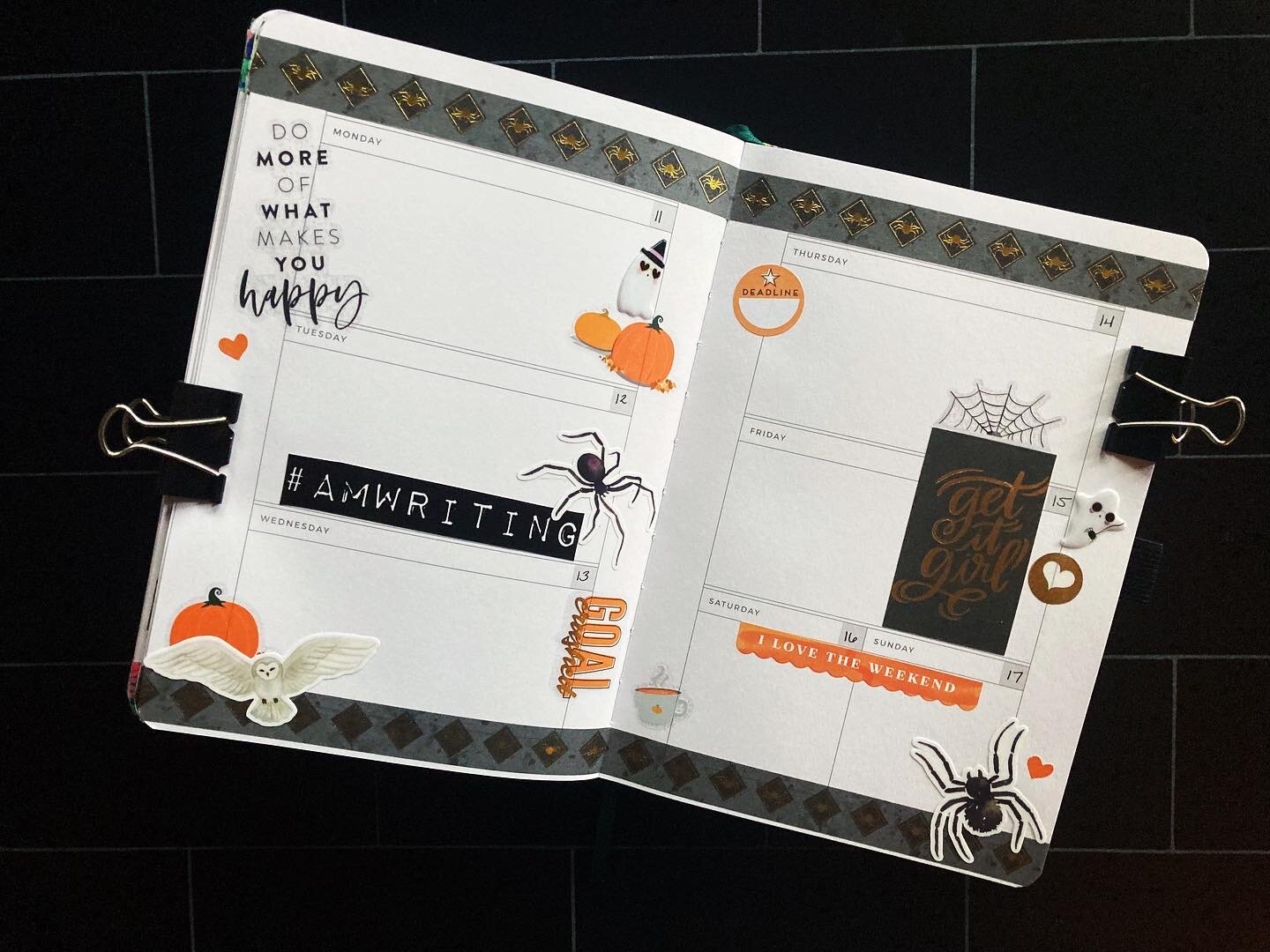
I do like to start with some of the bigger stickers and then fill in with smaller ones, usually hearts in a matching color or some other tiny detail.
Once the month is done, I move into the weeks, which allows for bigger stickers to be used. Often, I will choose stickers that correlate to an event. And when I feel a spread is done, I move on. I usually do this before a page feels too full. If I need to add a few stickers later, I will do so. But less tends to be more, and it is not difficult to go overboard.
Since I planned on using this last week as a project page, I took a thinner washi tape that has the coppery elements used in the first tape I applied, and covered the names of the week. I then added label stickers, though at this point, I wasn’t entirely sure what each section would be. However, getting close to the end, I did know I could use this to organize some dates and tasks for The Elpis Pages as I move into the next steps of that project.

The last page will be the monthly memory keeping spread. This will remain empty until the end of October, but I am planning on doing a September wrap-up soon where I walk you through this process.
6.) Spot Check

After all pages have been filled in, I go back and do a final check to see if any spaces need to be filled. This is usually the point I have my mom look through to see if there are any gaps that need to be filled in.
7.) Add Important Info
I start with the monthly calendar, adding bills due or important events that I already have scheduled. I fill in my goals for the month next, usually trying to account for what I accomplished the month before. I also try to keep these realistic. As a goal-oriented perfectionist, my old ways of goal setting was especially harmful to my mental health and I have since worked on making more manageable goals for myself.

I also add a quote for the month. Usually, this becomes a sort of mantra that I return to on the difficult days to keep myself grounded.
Next, I go week by week and add bills due, important events, and any days off I will be taking from work. It’s become a running joke since 2020 that I write in “work from home” every day. But in 10 years, I think it will be nice to see how long this continued.
8.) Add Tasks
Once these important items have been written in, I can add tasks that need to be completed that week. If I have a day where something important or noteworthy happens, I also use this space for memory keeping, but I’ll go into that during my September wrap-up.
For the final spread for October. I absolutely love the pops of color throughout and I’m even more excited for this spooky season. I can’t wait to see what October has in store for me!
Don’t forget to like and subscribe. And remember, no matter where the day takes you, dream big!
No Greater Feeling
While there are many elements and tasks needed to prepare and run a literary magazine or journal, the most important will be the submission process. This is where you will find work to publish. There will be much reading and tough decisions along the way, but there is no greater feeling as an editor than helping champion another author’s writing.

And throughout this publishing process, there is the reminder that we as humans must tell stories to stay connected.
While thinking about how you will receive and organize submissions may seem overwhelming, I find the best place to start is to look back on your own submission process. Were there any submission experiences that frustrated you? Was there an exceptional editor able to offer kind feedback in a rejection?
As I walk through each step, it might be helpful to note those successes and near misses you’ve experienced.
1.) How will you receive submissions?
In my time submitting, I have encountered a multitude of ways to submit my work. The three most common are email, Submittable, and online form.
Email may be the easiest option for you to use upon just starting this creative endeavor. It puts the work on the author up front to email their submission to you. You can set-up a free Gmail account under your magazine name and in five minutes or less, you’re ready to begin.
The time and ease of using an email platform made this a strong contender when I considered my submission process. However, one thing I know about human error is how unavoidable it can be.
Using email means your submitting authors will need to follow your submission guidelines for the correct email, subject line, word count, category, author bio or photo, etc. The more items needed, the greater the chance of imperative items being missing.
For myself, I am incredibly thorough when I submit my work. I keep a spreadsheet which tracks deadlines, submission process, emails, category, etc. I would hate to lose out on being considered because I didn’t properly follow the guidelines.
And while you can and should add in a note to your submission guidelines about what happens when authors DO NOT follow your requirements, many times these may be mistakenly forgotten. Email may seem easy for set-up, but I do find it leaves bigger room for error.
Submittable is a site familiar to most writers, which allows submissions to be uploaded, tracked, and updated from one system. Those submitting can add a cover letter, attach their work, and fulfill the payment requirement as well. The functionality is easy to use for writers and allows for discovery and exploration of open calls for submissions. Many places I have submitted to have been found this way.
Sounds great, right? Why wouldn’t we want to make the submission process as easy as possible for our writers? For many editors or creatives, recognizing the financial resources you can input into a project is key to your overall success.
While I loved Submittable and the way it allows for collaboration between a team of editors for each submission, ultimately, I knew I could not afford to use this platform. Long running magazines may have the financial backing from donations or from the press itself.
As I knew all proceeds from my collectives would be donated, there wasn’t wiggle room in my own budget to justify this price. For a basic plan, it is $99 per month or $999 when billed annually. This give you 3 team seats, 1 project, 300 submissions per year Autolabels, Payment processing, Yes/no voting, Team assignment, Batch email and templates, In-app messaging, as well as Dashboard and data exports. These resources are immense, but making sure you can financially support this platform will be key to your launch. If you have a team of editors splitting this cost, it might be less of a restriction.
While I’ve encountered a myriad of online forms, including self-hosting on websites, one that has become most common is Google Forms. Like most things, Google’s functionality is user-friendly, adaptable, and customizable. And for these reasons, I chose to use a Google Form for both Pages Penned in Pandemic and The Elpis Pages. This was especially key during the first collective when I had more than a dozen questions for the interview series that needed to be answered.
What I continue to love about this platform in this current submission process is the way it guides writers to every answer needed and allows me consistent places to look for that information such as author email, category of submission, word count, and the attached work.
2.) How will you organize submissions?
Once you know how you want to receive submissions, the next step will be discovering how you want to organize submissions. Much of this process will be informed by whether you are using email, Submittable, or online form.
For email, you may want to have separate folders to organize between genres such as poetry, fiction, creative nonfiction. If you have separate editors for each genre, maybe you will want to create separate emails for each category to eliminate confusion in your inbox.
For Submittable, the system will organize submissions for you, though even with the basic plan, there will be options for assigning to your teams, and tracking. In both instances, you may also want to keep a spreadsheet to track submissions, as this allows for all info to be in one place.
While I use Google Forms to collect my data, I do not use this for tracking or review purposes. Instead I use a combination of Trello and Google Sheets. As mentioned above, I find great value in having an overview of all submissions, which is why I track on a spreadsheet in addition to Trello.
For submissions, I use Trello to track from the initial read to final decision all the way up through organizing my publishing timeline, and final order of the collective before publication.
3.) How will you review submissions?
After you’ve decided how you’re going to organize submissions, it will be helpful to have a plan for reviewing submissions. Depending on whether you are working solo or with a team may affect this process.
For Pages Penned in Pandemic, I worked with my best friend, Justin Maher. We used Trello as a means to communicate. Most times, we would review submissions separately, making notes in the document. We would then have editorial calls to discuss our decisions, work through any edits, and assign emails to ensure we could personally respond to every author.
This time around, I am working solo, but am still following the same steps. When I receive a submission, I add it to Trello. Most often, I do not review the submission at the time it’s added, which is why it’s helpful to have the link to the document.
When I review, I do an initial read through. Sometimes, I will know instantly if I am going to accept a submission. Other times, I might go back and make comments or edits. There are instances, when I feel a piece needs to be placed on the fence, allowing me extra time to review. And as is the case with all submissions, there might be work that doesn’t fit with my preferred style or the overall theme.
For these cases, I do find having a theme can help guide decision making. We didn’t have a theme for Pages Penned in Pandemic, though we find many authors writing about the same things. The Elpis Pages requires submissions be about womanhood, though this is a broad topic.
4.) How will you send decisions?
Once you know which pieces you will accept and which you won’t, it is time to send decisions to writers. While there are many ways to do this, especially if you use Submittable and have the option for batch responses, I do find that my preferred way is kindest.
As a writer, receiving rejections is never fun. However, in creating my submission process for the collectives, I looked at rejections where I felt excited to keep submitting as a guide.
I always love receiving feedback and a personalized rejection. Now this might not be feasible for your project, but for myself, I knew I wanted to personalize every email.
Also, while you can announce your contributors on social media or send a rejection email with all others CC’d, I personally would not recommend this. It doesn’t recognize the courage or hard work of every submitting author. And without those submissions and brave souls, you wouldn’t have work to publish or supporters to keep the dream of this creative endeavor alive.
Don’t be a jerk, even if a piece isn’t right for your project. Do not respond if work violates your submission guidelines, threatens you or your authors, or includes content that is harmful, violent, or inappropriate.
I have been lucky this time around to not receive those kind of submissions. With Pages Penned in Pandemic, we did receive some submissions of that nature and we did not respond.
For this part of the process, you will also want to note if you are accepting simultaneous submissions or charging for submissions. As a writer, I think it is imperative to allow simultaneous submissions. This is a personal opinion, but knowing this, I also understand, writers might need to withdraw work, sometimes during the deliberation process, sometimes before you’ve gotten a chance to review the work.
Since proceeds from both collectives were being donated, we did not pay authors, but we also didn’t charge for submissions.
If you are looking for a way to further support your magazine or journal, a great option I have found is charging a small fee for expedited submissions or receiving feedback. Perhappened Mag does this extremely well. Charging fees for this allows monetary support to your journal to either pay your editorial staff or even more exciting, to pay your authors! Also, the fee for feedback or faster turnaround really cuts to most writers not wanting to wait months for a response.
Here is where I note that many, if not most, editors do this for free with only the love of literature as a reward for the time, dedication, and willingness to provide a platform for authors.
Once you’ve figured out these key elements, you will be ready to launch and open your submissions!
That’s all for part two of the Editor Diaries. I hope you’ll join me for the next part of this series while I dive into branding and social media.
Don’t forget to like and subscribe on Youtube! And remember, no matter where the day takes you, dream big!

Without Challenge
From the first spark of an idea to the finished product, I’m excited to demystify the process of starting a literary magazine or journal. For many writers, the dream of starting their own literary journal may seem beyond reach.

Often, I find the idea of a creative endeavor to be too big on its own. However, breaking anything down into manageable steps allows me to navigate the process with realistic deadlines and goals.
The journey may not always be instantaneous or without challenge, but reaching that destination is entirely worth it.
Inspired by the way I tackle my projects, I am going to take you step-by-step through the beginning stages of starting your very own magazine, journal, or press.
1.) Ask yourself WHY
Knowing why you want to start your magazine not only carries you through any setbacks that may occur along the way, but it allows future writers and readers to understand what sets you apart.
For my first collective, Pages Penned in Pandemic, I was already running a featured interview series on my blog where contributors shared their experience writing during the pandemic. As I compiled and posted those interviews, I became increasingly interested in reading those written works. Our vision was clear. Whether poetry, short story, flash fiction, novel excerpt, or essay, the work needed to be written during 2020, though it did not need to be about the pandemic.
Understanding our vision allowed us to conceptualize the end product before opening submissions.
Throughout those early days of the interview series, my favorite answer to read had to do with advice to young writers. During quarantine and isolation, I worried those writers didn’t have anyone to remind them their stories mattered. From this, I knew all proceeds could be donated to 826 National to support young writers.
For The Elpis Pages, the vision was a bit different, but the why was clear. I wanted to give a voice to self-identifying women, donating all proceeds to the Planned Parenthood Action Fund to support reproductive rights. After all, women’s rights are human rights. While I am still in the submission process of this second collective, I keep my why clear daily.
2.) Ask yourself HOW
Once you’ve clarified your why, you will need to figure out how you will run your magazine.
Will you tackle this project solo or will you be bringing on additional editors, assistants, or admins?
Whether working alone or starting with friends or a team, implementing clear goals and responsibilities from the start is something that can prevent overwhelm or bruised egos in the future.
You will also want to have a clear idea of whether you will be publishing work digitally or in print, as this will affect decisions later in the process.
How much of a financial commitment will you be undertaking? Will you be using a free website platform? Will you charge for submissions to fund your project? Will you be able to pay contributors?
For Pages Penned in Pandemic, I reached out to my best friend, Justin Maher, with a big idea for a print collective, wanting him by my side through it all. This seemed like the perfect way to stay connected during tough times.
In the past, I was a contributing editor for One For One Thousand, so I was used to working with a team. As the Editor-in-Chief for this first collective, I tackled admin responsibilities, social media, branding, cover design, interior book design, and author outreach. Together, we read and discussed all submissions, split emails, and worked on the final layout.
For The Elpis Pages, I decided to take on this project solo, as I felt it was my responsibility as a woman to provide a safe and comfortable submission process for self-identifying women. It also helps that I have the experience of one previously published collective to guide this next endeavor.
Maybe you won’t know how the workflow will be implemented. And that’s okay. It might be trial and error as you begin this new project. But having a general idea of how your magazine or press will run is crucial to future success.
3.) Branding
While the granular elements of font and color scheme are important, ensuring you have a consistent and understandable call to action and editorial approach are also integral to creating brand recognition.
So how do you know your brand? Combining your WHY and HOW will inform the development of your magazine.
If you find yourself struggling, take a look at other literary magazines and journals to discover what you love, what you like, and things you would change with your own brand.
While this may seem overwhelming, remember to take it one step at a time. Start with the name, then the aesthetic, then the overall voice of your press.
Coming from a background in marketing, this is something that feels like second nature for me. However, I still found places to research before launching each of my collectives.
If you are interested in knowing the specifics of how I created a recognizable brand for both Pages Penned in Pandemic and The Elpis Pages, let me know in the comments below.
4.) Social Media
While there are many fantastic videos already on Authortube about building your author platform, it is important to build the social media presence for your press as well.
To begin, I would look at which platforms you’re already comfortable using, or perhaps places where you’ve previously found submission opportunities.
For myself, I knew this was going to be Instagram and Twitter, as many of the places I’ve submitted my poetry and short stories to in the past were found on both platforms.
Since you’ve already determined your why, how, and brand, it will make the creation of your social media profiles easier.
From personal experience, I find it helpful to launch profiles prior to submissions opening. This allows you to start building your community, getting the word out, and building a persona future writers can trust.
5.) Submission Guidelines
As submissions are a major component of any literary magazine, press, or journal, ensuring you understand your guidelines before you launch will help your vision remain clear to future writers.
Some details to consider are general guidelines:
How many pieces will you accept?
What genre are you looking to read?
Will you be featuring a certain demographic or age range of writers?
Do you have a specific word count you’re looking to feature?
Will you accept previously published work and simultaneous submissions?
How will you handle pieces being withdrawn?
Will you have rolling submissions or specific deadlines?
Making sure what you’re looking for is clear can ensure you find the work you want to read and feature. But it’s just as important to note what you’re not looking for as well. This protects you from interacting with potentially harmful writers or situations.
Though beginning this type of project opens you up to new interactions, at the end of the day, your mental health and well-being needs to be prioritized.
In addition, it will be helpful for you to notes the author rights, payment, promotion, and response times.
I always find that detailed information protects both editor and writer from harmful or uncomfortable situations or unnecessary questions.
6.) Publication Schedule
Once you understand your submission guidelines, you just have one more step to take before you can begin designing marketing and branding materials and ultimately launching your new endeavor.
Knowing whether you will be publishing weekly, monthly, quarterly, or by special edition is something that will help guide your workflow and encourage your future contributors and readers to connect with you!
That’s all for part one of the Editor Diaries. I hope you’ll join me for the next part of this series where I dive into the submission process. I’ll be breaking down how I organize my submissions, how I navigate acceptances and rejections, and how I handle each writer’s work with care.
Don’t forget to like and subscribe. And remember, no matter where the day takes you, dream big!

What It takes
After wishing for years and talking about it for months, I’ve officially joined YouTube, and more specifically Authortube with the Newbie Tag! Taking the time to look back at my writing journey, inspirations, and dreams for the future allowed me to reaffirm why I love life as a writer.

1.) How did you find out about Authortube?
After grad school, I missed the community I’d formed with other writers. Well before this time, I was already watching book review videos, and especially loved watching Christine Riccio. Somewhere in that time, I started watching more authors talking about their work, and specifically loved Kim Chance, Alexa Donne, and most recently Lindsay Puckett.
As a writer, what I loved most was seeing an author’s journey much like my own, the endless days of writing before getting to the finished book. And it wasn’t until watching the book tour video for Again, But Better that I realized how personally connected I felt to that moment. I’d been watching all the way through Christine’s early days of writing to the title reveal, cover reveal, etc. Seeing her publication journey made me feel proud of her and served as a reminder that it was possible for me as well.
2.) What genres do you write in?
For this question, I will focus on my fiction, though I do write poetry as well. My current WIP is a YA speculative novel. My next project will be a YA fantasy series. I find even when I’m working on realistic fiction in a short story, magic creeps onto the page.
3.) What is your preferred writing tense, point of view, and category of story?
For poetry, I prefer second person point of view, which addresses the narration to “You.” This compliments the stream-of-consciousness style that in most of my poems.
For fiction, I prefer past tense, close third person point of view. While I have plans to write adult fiction in the future, my current passion remains Young Adult literature.
4.) Are you a plotter, panster, or plantser?
Before the pandemic, I was consistently a plotter. However, the ethereal way time seemed to move during quarantine invited me back to the magic of writing, which is often those places of unknown.
I won’t say I was a panster, though, because I did have a basic roadmap of where I was going. I prefer to use the term discovery writing. I allowed myself to live with the characters, to write with a loose destination, but making room for pit stops along the way.
5.) Are you a self-published, published, or yet-to-be published author?
I suppose I’m a little bit of all these things. My debut micro-collection of poetry, These Are the Women We Write About was published in 2018 by The Poetry Annals. Four of my poems were self-published in a collective this year. As the founder and editor-in-chief of Pages Penned in Pandemic, I knew I wanted to add my writing to this time capsule of 2020. This is currently available for purchase and all proceeds are donated to 826 National to support young writers.
For my WIP, a YA speculative novel about dreams, I will be pursuing traditional publishing. The last time I was in the query trenches with this novel was 2018. I took a step back in February of 2019 to overhaul this manuscript. This is the book of my heart, and I can’t wait to finish line edits and prepare to head back into the query trenches with you by my side.
6.) If you’re not yet published, what is your dream publishing house and / or literary agent?
From experience, I know how disappointing it can be to receive a rejection from a “dream agent.”
Approaching the query trenches this time around, I do not have a dream agent or dream publishing house. I am looking for someone who will love this book and champion this book and support my writing career.
When compiling lists, I think we can get close to finding people we might work well with, but ultimately, the magic comes from having conversations, and seeing how well you might pair with an agent or editor.
I will say that I have so many people in my life who support my writing. However, there is one individual who understands the importance of this sometimes dark and often unusual book. If I could clone him as my agent or editor, that would be a dream come true.
7.) What Authortube related videos can we expect to find on your channel?
For my channel, I will be creating a combination of the videos I love to watch on Authortube with videos I am always searching for. What does this mean?
I love videos on writing craft as well as personal process videos. I also enjoy watching writing vlogs, and of course, bookish content always brightens my day. You can expect this content from my channel as well!
As I’ve taken on different challenges and opportunities in my creative life, I found myself searching for videos to help guide me through.
While there are fantastic videos on querying, traditional publishing, self-publishing, and indie author journeys, I craved more videos about literary magazines. How to organize submissions, how to submit to journals and find reputable magazines to entrust your work.
Last year when I founded Pages Penned in Pandemic, I wanted more videos walking through the process of starting a press and publishing work.
All this to say, I will be walking you through the process of my next creative endeavor. After the events in Texas this week, I promised to support women by using my art to speak up.
How will I be accomplishing this? My new collective, The Elpis Pages, will feature work about womanhood by self-identifying women. Upon publication, all proceeds will be donated to the Planned Parenthood Action Fund to support access to safe and legal abortions and reproductive rights.
If you currently have writing that sounds like it might be a fit for this print publication, let me know in the comments below.
As we near publication, I will take you through the process of starting a press or magazine, organizing submissions, cover design, marketing, and final publication.
8.) When did you start writing?
I have a few stories from elementary school, all signed in crayon. But I suppose the moment I really started writing was in seventh grade during our poetry unit.
It wasn’t until my senior year of high school, taking an experimental writing class, when I fell in love with fiction, and I’ve been writing ever since!
9.) What was the first story you ever wrote?
In that experimental writing class, I’d worked on poetry and satire and flash fiction. But my first story was called “Through.”
For our final project, we were able to work on whatever we wanted. My best friend suggested I write a story about fairytales, or rather, fairytale characters. This was well before Once Upon a Time.
I loved that story. And I still love this story. I went into grad school with that manuscript and I have plans to return to that series after my current WIP.
10.) What authors have inspired your writing most?
There are so many that it would be difficult to name them all.
I’ll start with J.K. Rowling. After reading Harry Potter and the Sorcerer’s Stone at the age of eight, I knew I wanted to write stories of my own.
For this current WIP, my early inspiration came from Sylvia Plath, both The Bell Jar and Johnny Panic and the Bible of Dreams. I also owe much of the darkness and human authenticity in my book to Fell of Dark and Ten Miles One Way by Patrick Downes, Away We Go by Emil Ostrovoski, and We Are Okay by Nina LaCour. Others include the Uglies series by Scott Westerfeld, The Wicker King by Kayla Ancrum, The Riverman series by Aaron Starmer, Wild Awake by Hilary T Smith, The Giver by Lois Lowry, On Immunity by Eula Biss, Eurydice by Sarah Ruhl, and both The Song of Achilles and Circe by Madeline Miller. Greek mythology plays a large role in this WIP.
11.) Do you schedule your writing sessions or simply get to writing whenever you can find the time?
While I am a very organized person, it has become increasingly difficult to schedule writing time. I always know I have thirty minutes or so to work on my writing during my lunch break, and most of my weekends are spent either writing content for my blog or working on line edits.
However, as I take on this next creative endeavor with The Elpis Pages, I know how important it is going to be to schedule in this time to make sure I can write every day. And this doesn’t mean whole pages or cutting 2,000 + words, as thinning down my WIP is the current goal of line edits. Sometimes this means writing a poem, or a few lines of dialogue.
I do have a full-time day job, which has become more demanding in the past few months. Though time can be fleeting, I know I need a moment of writing to maintain my mental health.
12.) Do you type on a computer, typewriter, or write everything out by hand, or use a blend of both?
I would say 90% of my writing happens on my computer. But if I’m writing a poem or dialogue between characters (this often happens to me at the grocery store or on the road), I will use my phone.
For poetry, I solely write in the Bear app. When working on chapter notes or scene ideas, I write these in the Notes app on my phone or if I’m driving, I will use Voice Memos. I do keep a written journal, which is more for brainstorming. No concrete writing really happens here.
13.) What are you most looking forward to now that you’re part of Authortube?
First and foremost, I would say community. So much of writing is solitary, but my time in grad school, in writing group, and in collecting Pages Penned in Pandemic, these experiences have all taught me the value of staying connected, of finding a community to offer and receive support, and to feel understood.
I am also looking forward to having a tangible record of this next year as I work on The Elpis Pages and prepare my WIP to reenter the query trenches. There are so many milestones and roadblocks on the way to my dreams, and I don’t want to forget what it takes to get there.
Don’t forget to like and subscribe on Youtube! And remember, no matter where the day takes you, dream big!

The Write Place
Through the years, I’ve become someone who can write anywhere. I do believe there is a benefit to adaptability when it comes to finding time for words. But there is something to be said about a place dedicated specifically to the craft and growth of writing.

For me, this is my writing cave, which exists in the corner of my room as a sanctuary for stories. Sleep has often been sacrificed to spend time here. Whole worlds have been born from the ether of the universe in this space. I have grown as a writer and a person at this well-worn desk.
I suppose there are places that feel more comfortable than others because they allow us to be exactly as we are. Even as the world asks us to be different versions of ourselves daily, there is a magic to finding the you in a space.
However, I must admit this desk and the writing cave disappeared beneath paperwork and books and disorder during the last few months. In that time, I’d forgotten how much I loved this tiny corner of my world. And though we all exist in spaces differently, for myself, I know that a cluttered room leads to a cluttered mind.
I needed my space back. I kept planning to reclaim this corner, but alas, time felt fleeting. While we can and should make plans, sometimes life has different intentions. And as life is wont to do, it threw some disruptions my way, most notably by flooding my closet earlier this month. I didn’t plan for it, but it forced me to clear out and clean up the mess.
This opportunity was the nudge I needed to tackle my writing cave. And now that this space has returned to stillness and solace, capturing its importance here feels necessary.
The space:
As previously mentioned, the writing cave exists in a small corner of my room. It contains my desk, an alcove, a craft stand, and a bookshelf. So what makes this space special?

In part, I think it’s the careful curation of everything that makes me feel connected to stories. It’s history and memories and nostalgia and possibility. Among these treasures, you’ll find antique teacups, vintage books, typewriters, lighthouses, honeybees, pens, planners, and more. Perhaps this is the closest you’ll get, dear reader, to understanding my composition as a writer at the molecular level. This microcosm of personhood remains clear on the days when I feel lost.
The desk:

This is truly one of my favorite finds. In 2014, I wandered into a building near my hometown, which everyone calls The Barn. It is, in fact, a barn filled with items from ceiling to floor with no rhyme or reason. It takes hunting and a keen eye to find treasure. I did just that. I paid $50 for a desk that in perfect condition is worth 20 times this amount.
Alas, my desk is far from perfect. I love it all the more for its scars and history. This antique Limbert Arts and Crafts Library desk was crafted from tiger oak in the mission style during the early 1900s. The drawer has a place for a quill and ink.

Most convenient for an avid reader, this desk provides two sets of shelves on either side. Stored here are more than enough books to fuel my obsession with Grimm’s Fairytales, Greek mythology, and Alice’s Adventures in Wonderland.
The latest addition to the shelves is a canvas print of the Currituck lighthouse, which for those who know the world of my work-in-progress book, DREAM CATCHERS, you know how important this building is to me.
No matter where I go or what story I pursue, I know this desk won’t be far from my journey. We’re kindred spirits, meant to be in each other’s lives for always.
The alcove:
Four years ago, I knew this space needed to be transformed into my writing cave when I saw the alcove built into this corner. You see, dear reader, I’d started my own collection of antique teacups (my great-grandmother collected them first) and I knew this would be the perfect place to showcase them.

And as the years have passed and my collection has grown, my love for these two shelves has not diminished. I’ve added more than just teacups here. There’s vintage editions of Tennyson’s Poetical Works, Euripides, A Wrinkle in Time, Sonnets to Orpheus, Idylls of the King, In Memoriam A.H.H., various works of F. Scott Fitzgerald, Winnie-the-Pooh, The Wind in the Willows, Vanity Fair, vintage writing craft books, the April Poems circa 2020, Far From the Madding Crowd, a first edition collection of poetry by Edna St. Vincent Millay, Paradise Lost, and so many copies of Alice’s Adventures in Wonderland.
A more recent addition to this space is the lighthouse print gifted to me by one of the best friends to celebrate the publication of Pages Penned in Pandemic. Someday, dear reader, you’ll discover why lighthouses are so important to me. For now, I’m still figuring that out for myself.
The craft stand:

For Christmas 2020, my parents gifted me this incredible stand, which now houses my myriad of craft supplies. Whether washi tape or watercolors, I love having the ability to dabble in other creative arts when need be. I’ve utilized the space as much as possible, adding some framed prints of Alice exploring Wonderland (a gift from the other best friend) and some additional teacups!
The bookshelf:

While this is only one of the bookshelves in my room, this one provides so much to love and to feel inspired by when my own words feel more distant than usual.
At the very top, I’ve added some teacups (I now have 37 in total, though I’m starting to run out of room) with my Honeybee Farms sign.
Though the least visually interesting, the binders on the bottom ensure my curated writing throughout the years stays organized. These binders remind me to keep going without giving up. I’ve done it countless times before. I know I can do it again, so long as I try.

As I’m always trying to become the best writer I can be, I find having a collection of craft books to be just as important. This first shelf continues to grow, and so does my passion for my art. To keep myself tethered to where my current work-in-progress began, I keep a framed scrap of paper with an idea that I tied back to Camryn’s story a year after first writing it. It’s something to look back on when the drafts seem endless and the work feels unmanageable.

I know what you’re thinking: what would a bookshelf be without more books? Worry not, dear reader. Below the pens and markers and highlighters is a shelf filled with graphic novels, a beloved quote about brokenness, a beeswax candle shaped into a lighthouse, and a coffee mug with a beautiful origin and characters from a favorite show.
Just below this shelf are books about dreams and mythology and magic with some memoirs for good measure.
The essentials:
No writing cave would be complete without those last few items that make or break a storytelling session. For me, this comes down to eight items. Though water, coffee, and crystals are a MUST, they are not pictured below. The others include:

Macbook Pro
Moleskine journal (current edition adorned with an Ew David sticker)
Archer and Olive Planner
Felix Gray blue light blocking glasses
Headphones
Recently, I’ve been reading back through old blog posts. In doing so, I found one written before I turned 25. And in it, I promised a tour of my writing cave. I realize it’s taken four(ish) years to finally compile this here, but I’m happy I didn’t rush the post. The writing cave has changed, taking on more history and energy and stories than I ever imagined. And I have gone through my own growth since then.
I can’t wait to revisit this years from now in my next writing cave. I imagine it will have even more bookshelves and teacups, that I will still be writing from the same desk, only I will have a view of the ocean from windows that let in the afternoon light. Maybe this is more a dream than anything else, but in case you’re new to this blog, you should know I am a dreamer.
Whether you’re finding yourself out in the world or in a tiny corner of your home, I hope you’re able to be you, whoever that might be.
Just a Redirection
Though I’ve become acquainted with the process of submission over the last six years, this does not mean I have found success with every attempt. If anything, the more times I submit my work, the more chances I have to be rejected. It’s the truth, which many writers avoid discussing because it’s not the outcome we wish to dwell on.
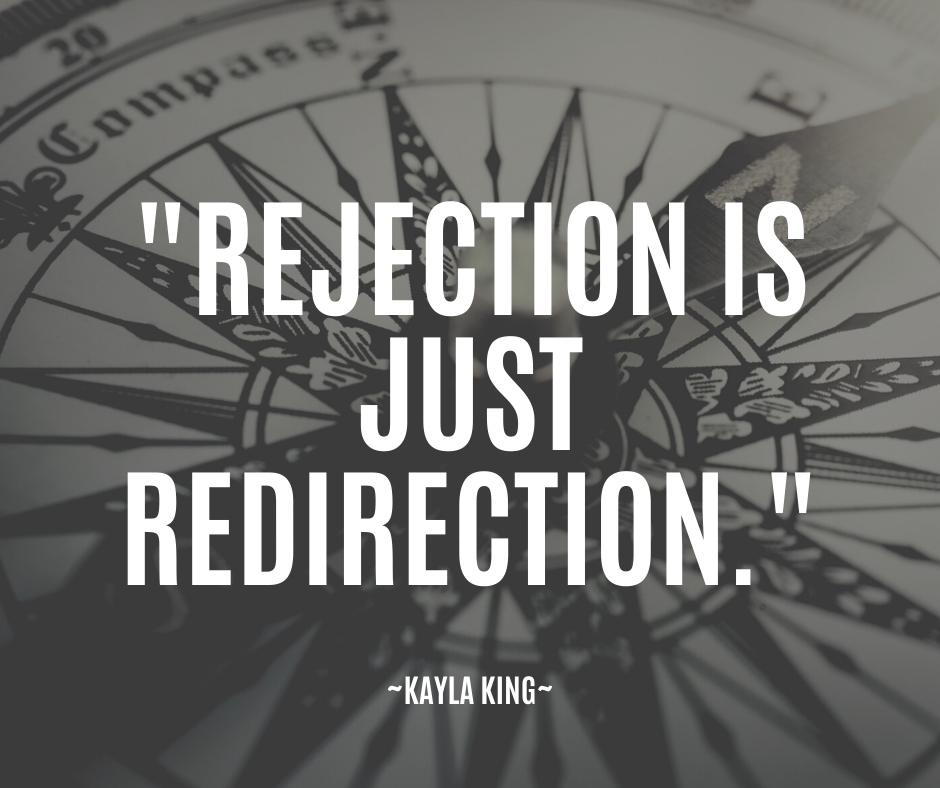
Alas, decisions are often beyond our control. I hoped to be be announced the winner of the Backlash Best Book Award. Despite making it to the shortlist, my work has not been chosen.
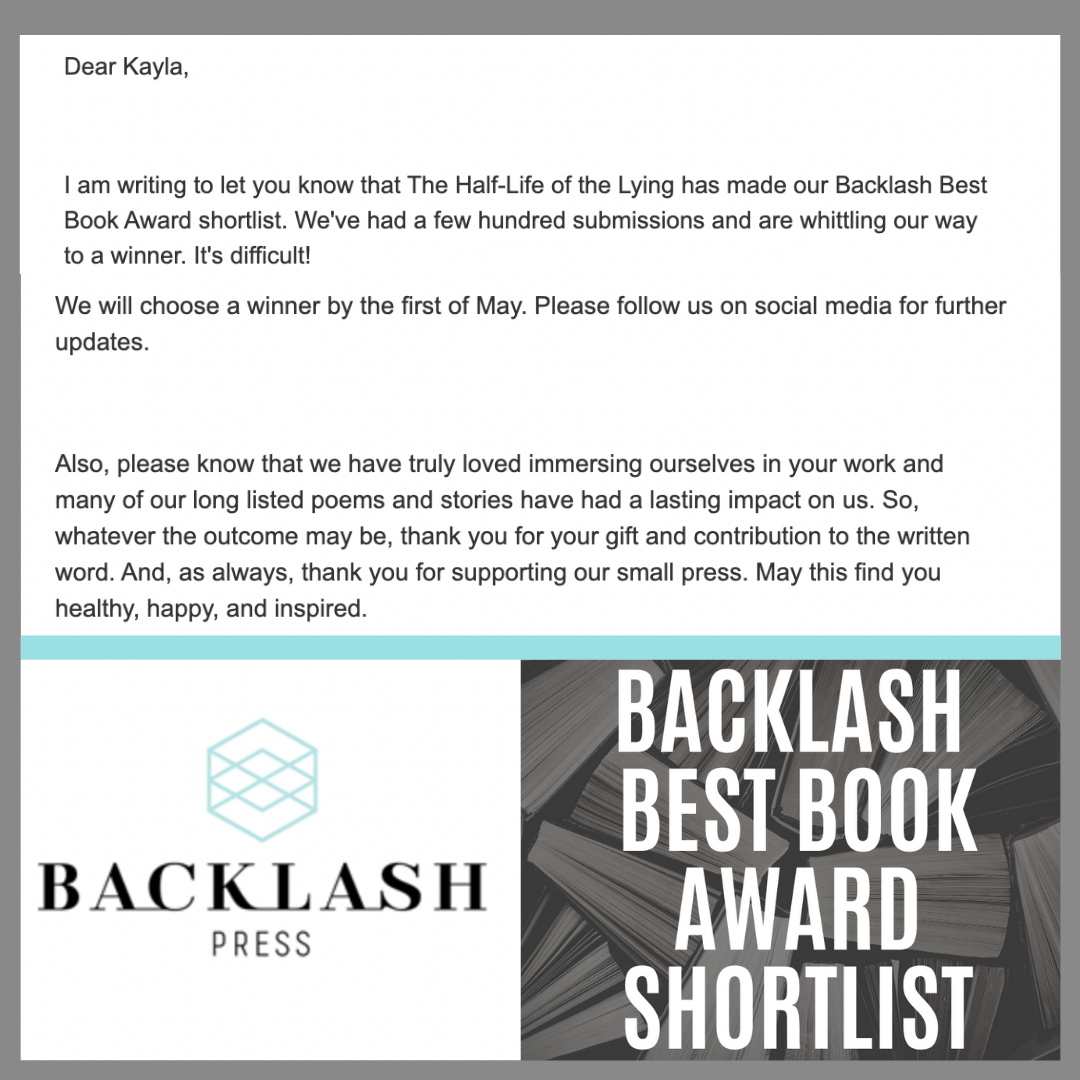
Rejection is just redirection.
While this news might be a little more sad than usual, it is by no means discouraging. I refuse to give up on this full-length poetry manuscript, which began in 2017 with me finding my voice as a poet again. The journey of this collection will not be over until THE HALF-LIFE OF LYING finds its forever home.

Looking at this letter, I am so proud of the obstacles my work overcame, climbing to a shortlist of three other manuscripts out of two hundred submissions. And I must admit, I do not know the word quit. I do understand the importance of hard work and diligence and perseverance.
In the past, I always liked the saying close, but no cigar. It felt a little out of time, which is how I often felt growing up. But despite the old soul connection of those words, I no longer find them to be applicable. And why is that? Well, dear reader, throughout the last year, I have learned the importance of celebrating even the smallest victories.
This world is not always kind and life is not always easy. Some days, survival may be all we can manage. But on those other days when we can enjoy the rain or recall how hard we’ve worked to get to a certain point, when we can love ourselves despite imperfections, and when we can take a step back and marvel at just how far we’ve come, those are the days when close is better than best because it means we haven’t given up.
So if you, dear reader, find yourself faced with rejection, I hope you will remember it is just a redirection. There will be a new journey, a different press, another chance to make your dreams a reality.
Believe in yourself. Take a deep breath. Drink some water because you’re probably dehydrated. And keep trying.

Pages Penned in Pandemic
I will admit there have been days the past few months where solace can only be found cocooned in a favorite blanket, the smell of fresh-brewed coffee creeping up out of the mug, a beloved show queued up and ready to binge.

But there have been other days which stand out as tiny accomplishments, heart racing, searching for some semblance of sense in the small corners of my world. These are the days I’ve written. Though unpublished or unfinished, it doesn't much matter, because the pages penned in pandemic are tangible reminders that life moves ever onward.
While thinking about these often messy, meandering, miraculous pages, I’ve found strength. I couldn't imagine surviving the state of our world without the catharsis of writing.
What's more, I wondered if other writers felt the same way. So begins a new series in which I'll be chatting about such pages penned and what it's like now as the pandemic continues.
Until then, I thought I would share a glimpse of what my writing life has been like during these times.
What does the pandemic currently look like in your city?
When I enter a grocery store, shoppers wear masks, they clean the handles of carts, and they keep at a distance. In this respect, I feel lucky. I know there are some who are outraged by some of the stricter standards in Buffalo and the Western New York area, however, I do feel some small semblance of safety in regards to these regulations.
What are some favorite books you've read during quarantine?
Some of my favorite reads have been Fever Dream, Morning in the Burned House, Moonstruck: Volume 1, and Kingdom Animalia. I've also taken part in a book club with some of my favorite people, reading Children of Blood and Bone, The Ballad of Songbirds and Snakes, and currently, The Guest List.
If you haven't been reading, what are some books you're most looking forward to reading?
Though I have been reading throughout the past few months, I absolutely cannot wait to devour Midnight Sun! Finding comfort in nostalgic bookish worlds such as stories from Panem and Forks has been a delight amidst the darkness.
Have there been any movies, tv shows, podcasts, etc. that have helped keep you at ease the past few months?
I have watched Little Women on repeat and sought comfort in perennial favorites: Home Again, Pride and Prejudice, Practical Magic, Harry Potter. However, I will say HAMILTON has completely taken over my life all over again!
As far as TV, there's too many fantastic shows to name them all, but some that stand out include So Weird (I rediscovered this beloved show from childhood on Disney +), The United States of Tara, Alias Grace, Teen Wolf, Schitt’s Creek, GLOW, Community, and as always, Parks & Recreation and Gilmore Girls.
I've been discovering some new podcasts lately and a favorite is certainly Mind Love. I also enjoyed listening to the So Weird podcast along with watching the show. Favorites I always return to include 88 Cups of Tea, First Draft, That Smart Hustle, and The Manuscript Academy.
How has the pandemic affected your writing?
While I'm continuing my work-in-progress novel, I certainly find there are days that are easier than others. Writing a post-pandemic narrative while living in a pandemic is at times strange and surreal, cathartic and chaotic. It's been six years with this story, but the concept of surviving versus living has becoming all too clear in these months.
Are there any projects you are excited to keep working on? If so, can you give us any details (no spoilers please!) about your project?
During the month of April this year, I wrote one poem every day to celebrate National Poetry Month, and I'm excited to continue to edit and organize these poems I so love. To read more about this project, you can check out What We Called the April Poems.
I'm also still tinkering with a story I've been working on for the last eleven years. I love this story now more than ever, and somedays it's just the escape I need from the reality of our world.
If asked ten years from now what the past few months have taught you about being a writer, what would come to mind?
I think the past few months have taught me the importance of kindness: to others, but what's more, being kind to myself. I have written about my struggles with anxiety before, but these weeks and months have taught me to take a step back, take a break, take my time while I have it. I've been working on bettering myself just as much as I have been working to make my novel into the best version possible.
Have there been any fellow writers or people in your life who have helped you stay connected during the pandemic?
Before quarantine and the pandemic, I was routinely meeting with a fantastic writing group in the Buffalo area. Since being home, we have continued to meet biweekly over Google Meets. Not only has this kept us accountable for our writing, but it has allowed us to stay tethered, which is much needed during these times of self-isolation.
Is there anything that excites you about the changes being incited in the publishing world in light of recent events?
The focus on diversity and the commitment to inclusivity, which began with the #WeNeedDiverseBooks movement, continues to make strides toward ensuring readers young and old will someday find themselves on the page. Though, there is no denying these are small steps in a much longer journey to a world far better than the one we currently occupy, there is resounding support from the agents and editors I support as they, too, remind: Black lives matter. Black stories matter.
Is there anything that worries you about the changes being incited in the publishing world in light of recent events?
While traditional publishing has always had its gatekeepers and strictures, now more than ever, the prospects for debut novelists do seem to be diminishing. This makes the possibility of publication more slight than ever before. Though I am doing everything I can to craft a story worth telling, there is always the chance a post-pandemic narrative won't sell amidst these unprecedented times. However, I refuse to give up or give in based on the difficulties darkening a writing journey too used to uneven roads.
Are you a plotter, pantser, or somewhere in between? Has this changed during the pandemic?
I would definitely say I am a plotter! I thrive on outlines. But I must thank a favorite writer for suggesting the notion of discovery writing once or twice. I prefer this term, discover, to the idea of flying by the seat of one's pants. In part, because I start with an outline, but also there is a beauty in discovering a story as the words unfurl before me. I've taken this opportunity to take a step back when needed, to listen to my characters, and to follow where they lead.
Where is your favorite place to write? Has this changed during the pandemic?
My favorite place to write is a clearing in the White Mountains just beyond the building where I received my MFA. However, it's been four years since I've been back. Since that time, I have found that writing on my back patio has been lovely as well. Though I've always wanted to be a coffee shop writer, I've never really found a way to settle into my story in such a public place. In these regards, the pandemic hasn't affected my ability to find comfort in writing from home.
If you curated a playlist for writing life in the pandemic, what top 5 songs would be on your list?
1.) Level of Concern - Twenty One Pilots
2.) Wait For It - Hamilton
3.) ALL of folklore (more specifically: the 1, seven, and invisible string) - Taylor Swift
4.) All Will Be Well - The Gabe Dixon Band
5.) Non-Stop - Hamilton
Without too many spoilers, what is your favorite scene you've written since the pandemic began?
The first scene that comes to mind occurs between my main character and her mom. There is a conversation about numbers and words, apologies and wishes and dreams. This scene is everything I've felt during these many months.
While the future is just as unknowable as ever, what is something you are most looking forward to this year?
I absolutely love Thanksgiving and this year, it feels extra special. But I must say, waiting for that first day of October to watch my favorite Halloween movies while wrapped up in a blanket, embracing an autumnal chill, a reminder that all things must end so that new seasons can begin again - this, too, feels like something to look forward to this year!
Is there any advice you would give to young writers during this time?
Once again, I can't stress the importance of being kind to yourself. Not everything happens in a day, but there is so much to be enjoyed and accomplished in twenty-four hours time.
As always, I would say, keep going. During these months, I haven't escaped rejection, but I refuse to give up, and I think this is the most useful tool in the life of a writer.
One final piece of advice: Read. Read everything. Read anything. Read good books and bad books and things some people call trite. Escape into stories and give your mind a rest from puzzling out ways to leave your mark and save our world. Great thinking comes from imagining and imagining is honed best through filling creative wells with stories.
Wherever you are in the world, dear reader, whether you’re a writer or just someone trying to make the best of pandemic times, I hope you’re staying safe and well and finding ways to believe that better days are on their way, if only in our dreams.

Chasing Answers to Something
Despite the many rejections of last year, I knew almost instantly what word I would choose to carry me into 2020. In the past, there was CREATE, BELIEVE, BETTER, PERSEVERANCE, and DREAM. Those choices took much thought, aiming for perfection. But alas, I’ve been trying for better instead of perfect. It’s a struggle, and maybe it always will be.

Historically, February is a difficult month. While it would’ve been more than easy to write these words on the first day of the new year, I think some part of myself knew I would need the reminder now. I’m sure there are too many reasons why, and maybe in other years, I would’ve convinced myself of some falsity instead. But not this year. Perhaps as words penned by someone extraordinary explain: “I’m chasing answers to something I’ve already figured out.”
Maybe I’m tired of hunting whatever this may be. Or better yet, I think I’m done outrunning what I already know to be true. And so this year, the choice to wait until February to proclaim my word for the year seemed a necessity. I needed to know I could make myself believe the power of my word before sharing it with you, dear reader.

And that word is: THRIVE.
I am reminded of this as I look back at photos shared last month following the devastation of the Australian fires. Amidst the blackened tree trunks, rose-colored buds bloom. They thrive despite destruction.
And so too must I, despite darkness and heartache, rejection and doubt and this often frustrating inability to stray too far from the path of the dream, however nonsensical it may seem.
I will thrive.
I’m getting better about trusting my roots to stay planted no matter the storms. I’m learning the limits between striving for success and settling for self-destruction, because the latter seems familiar, and by association, comfortable. And on days when the thunderous thrum of anxiety tries to upend my steady shelter, I’m finding a way to listen only for the rain. To relax. To talk myself through without making a list of everything that will and would and could go wrong.
Despite everything against me, I am immeasurably grateful for the generosity of my people, the ones who seek to remind me of my strength when I question it, the ones who share an entire year of stories in one journal, who discuss mythology and meditation and all the ways to breathe again. Here’s to the ones feeling just as lost, willing to sympathize with similar plights. To the ones climbing mountains while I’m still navigating hills. To my mother. To my sister. To my best friends. To all the many fierce females in my life who helped me write a line about the worlds we women must carry on our backs.
We will do so much more than survive this year.
We will thrive, because we must.
