Into the Trenches
Leading up to this point in my writing career, I always knew I would submerge myself into the murky waters of traditional publishing. It's taken research and advice from my grad school mentors, and what's more, it's been coming to terms with the fact that this journey is far longer than many understand, for the waters of traditional publishing to become a bit more clear. And after all of this research, preparation, and waiting, I've finally thrown myself into the query trenches.

Last Monday, I submitted to the first agent, and yesterday, I submitted to ten more, including my #1 pick. This isn't to say I felt ready in the moment, because hitting send on those emails was one of the most terrifying experiences in my life as a writer. But I did it, because that is the next step. Going into this process, I know what usually happens now--rejection.
I look back a year ago when I last wrote about rejection (which you can read HERE) but since then, I've become more accustomed to being rejected. From the beginning of this year, I set a goal of 50 rejections for 2017. At the end of last year, I had a total of 36, and now it's August, and I'm already at 44 rejections for this year, which means I will probably exceed my goal of 50. But that doesn't horrify me, because it means I am being aggressive about sending out my work, taking leaps, and putting myself out there to the publishing world. And no, it's not always easy, but that's okay.
Now, less than 24 hours since sending out my queries, I keep rereading my first "rejection." I thought it would be more of a soul-crushing experience, and once I have a few more book rejections, that feeling might change. But right now, I have a personalized rejection, which for those outside the realm of writing and querying, is something to be proud of.
Most agents when passing on work will send a form rejection to expedite the process. But this agent personalized mine, offering words of encouragement about my dialogue and concept, which he found "really intriguing." He even offered me the opportunity to resubmit pending significant revisions.
At this point, I am confident in my first chapter, but am waiting to hear back from my lovely BETA readers to see if this is a recurring problem. Either way, whatever I choose, it is thrilling to think someone took the time to read and respond to my work. I'm sure this will be the only one I hear from for a bit since most agents say they take anywhere from 2-3 weeks to 4-8, sometimes even 12 weeks to respond. And they might send a form rejection after all that waiting, but it doesn't matter, because I believe in this book and this process and the future of my publishing career.
Staying positive through this really helps, I promise. But there have been a few other things, which have helped along the way:
1.) Support:
First and foremost, I must once again share my thanks for the ever-amazing army of supporters (who I wrote about HERE). Even from within the query trenches, they're still going above and beyond to support me and this book. They are reading my words, sharing their thoughts, and offering me their guiding light from near and far away.
2.) Organization:
We now live in a time where resources such as Query Tracker exist! For any writers out there nearing the query process, I suggest you use this free service to help organize (and research) the many agents you will be sending your work to in the future. There is an option to add agents to your list while keeping updated on the query as the days pass. It shows when certain agents are closed to queries, and will even show the success and failure rate of other writers querying their work.
3.) research:
I don't know what I would've done without Manuscript Wish List: both the website and the hashtag. Many of the agents I've submitted to have been ones I found using #MSWL on Twitter. Here agents will tweet about their must have books, and I found many tweets, which seemed to correlate with what I was writing. By using the website Manuscript Wish List, writers can either search certain agents or just go through the alphabetical directory to find specific information based on what agents may or may not be looking for, what genres they represent, and how to query them. It is a great resource, which can help writers personalize their queries to agents.
For those non-writers who've been following along on my journey, I hope my time into the trenches has taught you just a snippet about the arduous process of traditional publishing, and I hope it helps you understand the magic and madness of being a writer.
And for those of you struggling through writing your queries, I suggest using Writer's Digest Successful Queries series to help you write a letter that will stand out from the slush pile. But for any of this to happen, you need to finish that book. So finish it! Stop waiting to be ready, because as Lemony Snicket says:
"If we wait until we're ready, we'll be waiting for the rest of our lives."
To all you readers who are also writers, I believe in you. I believe you can do this, and I can't wait to read your books someday. And I can't wait for you to read mine! Until then...

Out Of the Mind; Onto the Page
From the moment I wished the best friend a happy birthday today, I knew I would write about him, amongst other writerly things. You see, reader, the best friend is sometimes a writer, and sometimes he's my editor, too. We have a great working relationship because we have a best friendship, which has lasted eleven years now. And the wonderful thing about this best friend is the way he continues to inspire and motivate me and my writing. He is adventurous, brave and kind, quick-witted, sharp-tongued, and filled with more humor than I'll ever possess; he's my spirit animal.

Earlier this year, I wrote a stream-of-consciousness story for One For One Thousand entitled, "Twentysomething", and you can read that story HERE. After reading this piece about Snapple and bus rides, the best friend suggested we each send an SOC every day consisting of a minimum of 200 words. We started off really well. Some pieces were short, and others were longer. Life got in the way, as life often does, and we no longer send an SOC every day. But we are still writing them. And two days ago we had hours worth of texts that were only SOC bits, which have crafted a kind of story we might finish someday. Someday. Maybe.
As usual, I'm sure you're wondering what this has to do with my writing journey. You see, in grad school, I always loved the pressure of a timed writing session. Don't ask me why, because I'm still trying to answer that question. When I look back, I think, perhaps, the timed sessions allowed me to think of only the work at hand, to keep myself out of my own head, and to write for the sake of writing. All those times produced poignant writing (just ask my MFAmily), and all those times were stream-of-consciousness. For those who don't quite know what I'm talking about when I say SOC, it's the kind of writing, which happens when you write and write and write without stopping, without rereading, without thinking ahead of the word or the sentence you're completing. Sometimes this kind of writing produces gibberish, and sometimes it captures magic. I've found this to be true the past few months as the best friend and I have traded these small stories back and forth.
One of my favorite SOCs happened after reading the best friend's at 3am before falling back to sleep.

The words of his writing became enmeshed in my dream, and when I woke, I started a response based on that dream. When I sent mine, the best friend couldn't believe I'd written it half-asleep at 4am, and because of its potency and poetic perfection, I have a hard time believing it, too. Because there are days when the writing is grueling. It feels forced. My elbow aches as I type and delete and retype. And then there are small moments like the aforementioned where I know I'm a writer. I think people like myself who produce whole words from nothing, we need those magical and mystical times to get through the hard days.
So what has stream-of-consciousness continued to do for me, and what can it do for you?
Well, in the former aspect, I have found a voice clear from outside influence, and a sharpness I so love. Many of my poems I've since submitted for possible publication have come from these moments of SOC. And I know these strange writing prompts keep the best friend and I connected though we live hours away. In his writing, there are knockout lines, which take my breath, and hold me hostage for a moment or more. That's something about us writers; we appreciate the power of poignant writing. And I am constantly reminded of the best friend's goodness. Last year I quoted lines from "For Good," on his birthday, and this year I'm further convinced of our truth in that song. I know how lucky I am to have the gift of writing, but what's more, to have my person. He is a fierce friend, a ferocious wanderer who often wishes to bring me some of the joy he finds in the unknown. He's a Leo--through and through. And I appreciate him every day, but especially today as he finds the other side of 25.
Now in the latter aspect of stream-of-consciousness writing, I hope you find your fears and your passions brought out on the page. Even for you non-writers out there, I think the act of unspooling yourself in words can be cathartic and help you discover hidden truths you didn't know existed within you.
I've been playing around with this idea of truth lately in my poetry and the collection I'm building from therein, and in doing so, I've been trying to be more honest with others and myself. I guess, in that respect, I am a Cancer--through and through. But whether you tend to bottle up emotion, wallowing in the ephemeral beauty of denial, or even hate the idea of writing, the benefits of stream-of-consciousness might be your new found best friend. All you have to do is put pen to paper, and let the words flow.
Ready? Set. Go.
It Takes a Kingdom
It is a truth universally acknowledged, that it takes a village to raise a child, but I promise you, it takes a kingdom to raise a book. Now I've written here many times that I *finished* my novel. And I'm not going to say that any of those parts of my journey were not exciting, because they were. But I'm here to say I *actually* have a finished novel. My novel.

How do I know this is THE completed draft?
After sending the document to my Kindle, (which not only worked as an extra editing technique, but also made my book seem real) I read and read and didn't have anything more to add.
Now I'm not going to say I didn't find any stupid mistakes, though, after all this time, I was hoping the writing would be perfect. Oh, what a fool I still am sometimes! But what I did discover is that this feels and reads like a real book. And I had a thought of, "wow, I wrote this. I actually write THIS book." I'm not only proud of all I've accomplished, but I'm proud of the writing, the story, and the actual book.
Maybe you're wondering what this has to do with my journey as a writer, and the journey of this book, so I'll tell you. It takes real commitment and courage, not just creativity to write a book. And sometimes I forget that a non-writer might not understand what this experience is like from day to day to month to year. It took someone talking about "real" jobs and expectations and frankly, not understanding anything I do, to prove my own resilience and my own determination to make the dream of publishing this book a reality.
Now I'm used to rejection. Really, I am. But these words from someone I love and respect hurt more than I thought. I went back to my computer that night, and reread my words. I typed END OF BOOK ONE, and I sent the draft to be spiral bound for someone else to read. And at that point, I knew the support I gave myself was enough.
The next day, however, I posted a picture of my book on my Kindle. I didn't want to forget the excitement of reading this straight through for the first time without a red pen. It was just me and my characters and the words I'd so lovingly crafted and killed and reconfigured to be the best they could be to tell this story.

My aunt was the first to comment on the post. She'd volunteered to read the pages that night even though she's not much of a reader, and the gesture was so heartwarming because she's been with me on this journey for the past three years. She was there to road trip for residencies in New Hampshire. She's listened to me prattle on about possible plot points, and she even brought champagne when I finished my final chapter a few months ago. She's amazing.
And then a childhood friend (Jess, I'm talking about you!) wanted to read the pages. And then my cousin (Lindsey--this is you!) also wanted to read. And all at once, the people with whom I'd found a real kinship in grad school started volunteering to beta read my book. One even wanted to see a chapter from a peer workshop, which still exists, but is much better now. And she reminded me of my army of supporters, my kingdom of people willing to love this book, to love me and my writing; they believe this will be published someday.
Before this day, however, I had other support, too. My mentor from grad school had already helped with my query letter. She is amazing, and she is the reason this book is what it is today. The best friend called and talked for a few minutes and helped me see how Chapter Seven could be better, and now it is. My other two best friends from grad school (Erin & Alicia, this means you!) have the pages and they, too, have been my strength through these many months, nay years, of writing this book.
I have my mom who taught me to be a reader first and who's let me be the person I needed to be to write this book. And there are others, too, who I knew would read this, including friends who are more like family (Amanda Maher, I'm talking about you!), and people who I've never met who remind me that my story idea is intriguing and as someone said, "impressive." Then there are the wonderful members of my 1:1000 family who will be reading this in their own time, and who continue to cheer me on from different states and countries and time zones!
But my people, my tribe from grad school (Mell & Erika & Meg & Amanda) were the people who reminded me it takes more than a village to raise a book. It takes a whole fucking kingdom. And their support means the world to me.
Now this wasn't the post I was planning for this week, but I never want to forget the way it feels to be loved and appreciated and uplifted from the brutality of rejections and revisions and editing to this feeling of absolute belief that I can do this!
And I can.
I believed it so long ago, and now I'm making it happen with the support of my kingdom of writers and readers and kind souls who are here to raise this project to be a real book you might get to read someday. All that's left is to finish the synopsis (insert dread), revise the query letter one more time, and then throw myself into the query trenches. Until then...

Enemies Of the Every Day
As a writer, and as a person, I grapple with self-doubt, as I'm sure is true for many of you. But Sylvia Plath reminds me to move past this enemy I face every day to find the words, which want to be written. One of the ways I've been tackling my own self-doubt as a writer has been to find my way back to poetry. And the Plath Poetry Project has helped me do just that!

My calling to be a writer did not begin with fiction (unless you count that story from second grade about a turtle becoming king, or the other more fantastical tales I signed in crayon), but instead, began with poetry. I can still recite my first limerick I crafted, and still remember the moment I felt like a real poet.
In middle school, the mother of a childhood friend who lived at the end of my street was killed in a car accident, and the only way I could think to process the news was to write a poem. Now many might think the moment this poem was published was the time I felt like a real writer, and maybe for some the validation of seeing their words in print is that moment. I know all these years later the first time I did see my words published by an online magazine that, yes, it was an incredible feeling.
But the moment when I realized my words could help someone other than myself, is the moment I felt called to the page. That same childhood friend read the poem I'd written at her mother's funeral. I still remember the sound of my words from her mouth, voice so small; too young to have had to deal with such a thing.
Now fast forward. I am a writer. And while I love writing, really I do, there are some days, which are difficult. There are moments when the creativity isn't there, when the excitement is just out of reach; the times of day when I stare in front of a blank page hoping something will happen. And if I'm being honest, these are the days, which scare me the most. These are the days when I wonder if I am really a writer. For those non-writerly folk out there, this might seem completely nonsensical, and I assure you, it is, but I'm not sure how quite to explain where the writing comes from.
Alas, I digress.
It is in these times when I feel self-doubt more than anything else, which never makes the writing any easier. Sometimes our own self-doubts outweigh our self-worth, but still, we must continue onward.
While I mentioned writing poetry in middle school, I must also admit I wrote many a melancholic poem in high school as well. When I took Experimental Writing for the first time, however, I abandoned poetry for a new love of fiction! I started a book, which I am still working on today, some eight years later, and I started another book, which I refuse to ever look at again. And sure there were some poems here and there. I took a poetry class in my undergrad. I discovered that I am a writer who cannot resist the trappings of lyrical language. Through all of this, I never felt like a poet, not the way I had all those years before. I didn't feel like I had found my voice as a poet like I had in writing fiction.
The Plath Poetry Project, however, helped me find my way back to poetry. It helped me find my voice. I've been following along with this writing challenge since April and have completed twelve poems in the past few months. My poem, "Sacrament," was featured in the first retrospective of this project, and you can read that work HERE.
Now you might be wondering what this Plath Poetry Project is all about. The home page asks:
"What is the relationship between discipline, inspiration, and external pressures?"
The project serves to help writers answer this question. By following the writing Plath produced in her last year of life, I have been writing a poem (sometimes more than one) each day Sylvia wrote a poem, taking inspiration from the work she created. Not only has this project helped me feel closer to one of my favorite writers, it also brought me back to poetry. It helped me cultivate a pamphlet of poems, which has since been submitted for a contest, so keep your fingers crossed for me!
Two nights ago, I finished my latest poem for this challenge, and I was reminded that self-doubt is indeed the worst enemy to creativity. Since I've stopped doubting my ability to write poetry, to have a unique voice, to actually sit and write, I have felt more creative. And on the days when the words aren't quite there, I still find myself drifting toward a line or two that might grow to be something more.

I am hoping when I check back in at the end of this project that I can say I successfully wrote all 67 poems, just as Plath did in her last year of life. I find myself wondering more and more what kind of work we might've had from Sylvia today. But the thought is wishful thinking. It comes and goes. I open up to a blank page, and I wonder, and I write.

Do Better
It's the eve of my 25th birthday, and I've felt so much building to this point; the quarter life crisis, the paralysis of this place in my life, etc. I don't have a name for it, though I named a story with a similar sensibility, "Twentysomething," because that felt most true.

Here's the thing: I think it's difficult talking about the trying times in our lives when we're in the trenches. In retrospect, they seem easier, maybe even manageable, because we've already made our way through them. But in the moment, the dark days seem darker, and the world seems scary.
I could tell you about the months of feeling incomplete and nowhere near enough of the person I used to be. I could tell you a story about moving an hour away from my hometown and living out of boxes for a month. But what I want you to remember is not so much that I lived in a mess, but that I was a mess. I found myself feeling bitter, not better. Now, I feel like life is too difficult some days to not be on the verge of greatness. And there is the moment before coffee when the world still feels impossible, but I face it; I'm stubborn I suppose.
I was recently told that maybe, it was time to give up on my dream. It was a fleeting moment, but still the words existed. They were real. And if I were someone else, maybe I'd have listened. But like I said, I'm stubborn. I'm a dreamer. I'm a writer.
But you know this. There are certain things you know from this blog, and other things you'll never know. I'm hoping to share more of the unknown with you, dear reader.
I'm going back to my weekly posting schedule to keep the moments of this journey clear, and here's what you can expect in the posts to come:
Stream-of-consciousness writing, and how it's helped me find consistency
Writing along with the Plath Poetry Project
Completing my first poetry collection
Tour of the writing cave
Querying process
And more!
So. Much. More.
There are too many things I want from this life. I want work I love, and I want my words to find their place in the universe. I want to read a book and love it. I want to love reading again. I want to love the days while they're happening. I want to find happiness.
And there are too many words, and not enough time; the minutes move by, and I'm almost 25.
One thing I know for sure: I used to believe in putting good into the universe. But maybe it's just giving good to yourself.
So be good to yourselves.
Be messy.
Be kinder.
Be better.

Finis
This time last week, I was handing over the *finished* draft of my manuscript to the best friend. I had spent the days leading up to that moment inputing the last of my hard-copy edits, and writing a few new chapters to fill remaining holes in the narrative. The process was extensive, and without the best friend's looming departure back to NYC, I'm not sure I would've finished in time. Since writing "End of Book One" two months ago, I have been editing and polishing words I'd already written. And I'm not sure the act of revision will ever not seem strange.

I wrote the last words. I printed the draft. I even added a faux cover just to make it seem a bit more official. And with the pages in the envelope, I had an overwhelming sense of excitement and terror. Now I know the best friend will be honest and will read these pages with care. He has been my editor since the moment I started writing. He was the first person to read my first book all those years before. He read this book back when it was only 100 pages of my thesis, which needed to be edited overnight. And now I am excited for him to read where I've taken this book, and also terrified that it won't live up to the years of work I've already put into the writing. But I suppose being a writer is like that most days; always teetering between fear and fragility and obsession and love. Or at least that has been my experience with writing.
This same day, the lovely ladies at Hooked to Books sent me the loveliest of gifts; a signature pen, which this writer will put to good use. And it felt like a sign that I was really done. The kindness was too much. Too often, as writers, we do the work alone, and we forget there are other people in the world. But this gesture reminded me that there is support beyond the writing and the world crafted in the mind and put down on the page.
Maybe this doesn't feel noteworthy, or rather, blogworthy to those reading from a different time or place. But as I compile names of possible agents and rework the synopsis and try to craft a query letter that will stand out amidst the slush pile, I'm not sure I want to forget any part of this process, which is why I am committing it to the memory of this blog.
I've since sent the manuscript to my two other best friends, and I know they, too, will handle this work with care. They will also be honest and critical and everything else we were taught to be in our time in the MFA. They understand the work and edits and the writing better than most. They are my people. They once again reminded me that this process doesn't have to swallow me up alone.

The Careful Undressing of Curses
Corey Ann Haydu's newest novel, The Careful Undressing of Love, offers an interesting premise: the girls of Devonairre Street are cursed. Any boy they love is destined to die. We are introduced to Lorna, one of the Devonairre Street girls for whom this curse is part of every day life. And to make matters in this book even more complicated and intriguing, these girls live in an alternate version of the Brooklyn we know.

Haydu gives us a world in which Times Square was bombed in 2001, the Twin Towers still stand, and the world crumbles and rebuilds in much the same way our world has in the aftermath of 9/11. This works as a significant underlying disturbance to the other moving pieces within this novel, and is handled with the understanding that one event has the power to incite change. As someone who was young when the Twin Towers fell, I've had to live through such changes; our world is also one which exists in the after.

Instead of studying the who and the why of such events in a history book, Haydu's characters must study the history of those "Affected." This small change to the realities of our world depicts a poignant look at history, and a way to further alienate the main protagonist, Lorna, as she deals with the death of her father from the tragic bombings. She must live with the notion that she is now one of the Affected, whom people study and memorize and remember. Such is a difficult idea to live with in a world where devastation is commonplace, where lemons are used to handle grief, and where tea is to be consumed with more honey than anything else. But even those things can't keep bad things from entering the lives of those who live on Devonaire Street. After all:
"we can't stop the world from happening."
Haydu's literary realm is an odd world that is not quite magical realism, but which exists with a touch of those elements. While the premise is enough to intrigue any reader, the world building is rich, and real enough to feel like home. Haydu's characters are flawed and flirt wth the idea of love despite the fact that any boy a Devonairre Street girl falls in love with is then fated to die. It happened to Lorna's father, and her best friend's dad, and her other friends as well. Death has taken husbands and boyfriends, etc. But the curse doesn't feel real to the girls growing up in a world of after until a local love and friend to all on Devonairre Street is killed.
The reality of the curse seems justified.
And still Lorna doesn't believe. Lorna doesn't want to believe. She has her garden and her mother and her friends and her boyfriend who she-doesn't-love-but-maybe-sort-of-could-love. It is all complicated in the best way. And through all of the many complications within the outside forces, i.e. the curse and the bombings, there are still the complications of the human heart. Most profoundly, Haydu writes:
"Maybe you never know if you're in love or not...Maybe no one knows, and we all wander around talking about it like it's something tangible and knowable, but actually we're all full of it. Maybe even the people who say they're in love are wondering is this what they meant?"
While Haydu writes with this same kind of philosophical musings in her characater, Lorna, this style never feels out of place. The Careful Undressing of Love is a literary YA novel with a lyrical language, which puts many adult works of fiction to shame. There is an essence of wondering about life and the world and love that we have all felt within our youths, which, perhaps, carry into the people we become as adults. Because there is such a lush and luxurious writing style within this novel, this will appeal to both young adult audiences and those older. After all, the best books in the world have been written about death and love and this book combines both aspects of life with a devastating sense of wisdom that only comes from losing those we most love.
And then there are the girls (and boy, they are LornaCruzCharlotteDelilahIsla), and they offer the best that an ensemble cast of characters can: variety, authenticity, and more truth than can be handled in one sitting.
While I easily could have finished this book in one night, it was the kind of novel that I wanted to savor for fear that another of its kind won't reappear any time soon.
Then there are the mothers of these girls and the mother to them all, Angelika, who keeps the rules of Devonairre Street so they may never forget the men and the love and the curse that tears both things from them in time.
There are the rules: honey cake and shared birthdays and long hair and honey in lavender tea, gardens and benches and lemon trees. Lemons for grieving and wool to keep out heartbreak and love and loss. Skeleton key necklaces provide them with literal keys when they can't seem to find the key to the curse. They can't seem to break the cyclical nature of love and death and dying and loss and mourning the love. Though they try to fill those spaces with donuts for anniversaries and red and white braided bracelets, whiskey and wine, music and memories and pictures; all the items they must keep for fear they might forget. It is enough to make one's head spin, but which Haydu writes into perfect clarity. Of course wool must be worn to funerals, and of course lemons must be offered to those suffering a doomed and damaged heart.
Then there are lines that break hearts beyond the page:
"There is a quietness that is quieter than other silences. There is a line between what feels crazy and what feels acceptable, and when it's blurry, the world is a scarier place. There is a time of night when you haven't slept and anything seems possible. There is a kind of sadness that feels so heavy and tight that you would do absolutely anything to not carry it anymore."
Much of the book is composed of soul-searing prose that is so beautiful it has the power to break the reader. And there is more to learn about Lorna and the Devonairre Street girls between the pages of Corey Ann Haydu's newest novel, The Careful Undressing of Love.
Writing this review, I'm listening to Lana Del Rey's song This Is What Makes Us Girls because it puts me back into Haydu's world of curses and love and loss.
At times heartbreaking and inspiring, this brilliant novel is sure to keep readers thinking about the cursed girls of Devonairre Street long after the story is finished.
Birthday Letter
Dear Sylvia,
Your once beloved beau wrote a final collection entitled Birthday Letters that I have yet to read. But I read that today it is your birthday, (though it is actually October 27th) and I might never read those poems because I didn't love Crow the way I wanted to, and I suppose this is because your voice, your poetry, has already possessed me.

Though you're gone, I said a small, "Happy Birthday," just because. But this wasn't enough, because you were a poet and I am writer and I think it is only in the written word that you will feel the sentiments of that birthday wish.
And I wonder what you might've written had you found a way to bottle your illness long enough to make it to today's medicine. I would say today's understanding, but such a thing doesn't seem to exist now. And I wonder if you would've marched last Saturday, the taste of disgust like the bitterness of pills left on the tongue too long without water to ease them down. Would you have plastered a poster with images of bees because your father was Otto, King of the Bees, and he'd taught you long ago that the Queen was meant to be more? More than rights stripped away and choices provided by men who will never know what it is like to feel the moon of a womb or the wane of loss. Would you sit at your computer and vomit a compendium of poetry about the plight of womanhood amidst today's technology and jarring juxtaposition between all we have accomplished and all we choose to forget?
I've wondered a great many things about you.
Sometimes, I think I feel your darkness. And maybe it isn't mine to claim, though that sort of depressive darkening runs in my blood from a paternal place. Maybe this is the same darkness, which ran in your veins, like ink that takes more than just black to be created; you add the blues and the purples, the bruises no one will ever see because all they know is black and white. Maybe that substance, whatever you'd like to call it now, floats in the ether of creation before making us into these people, these writers of words and dreams and draconian dependencies that keep us chained to the pen and the promise of splitting our souls for others. Sometimes we call it love or burden or beauty or art.
Oh, Sylvia, I want to open to the pages I've annotated with my own thoughts, but I've left your work at home in exchange for a new novel, a collection of short stories by Neil Gaiman, and a book of poetry called Beautiful Zero. And I never thought I would miss your collections so much because they have been too many places with me.

You do not come to people lightly. It is full on obsession and love because there is something within you that we understand. When you took your life, maybe you erupted into particles reincarnated within us all.
I remember that one poem you wrote, and imagine the people around you as the thoughts filtered in.
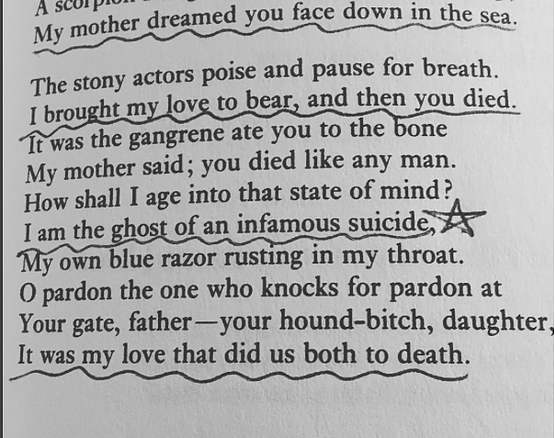
I remember my poetry professor from my undergrad who never talked about you, and I wonder why. Because he talked about Dickinson and Pound and recited the myth of Orpheus and Eurydice, and he brought the works of Spicer into my life, and Spicer wrote about Lorca and Alice, but never about you. But you were there in that collection from the Strand, and the dolphin seemed to resurrect you in writing, and you were there in The History of the Unmarried, and I cried a little at the idea of death in that one poem because Mills is scared of the way it might separate him and his love and their love seems more understandable because he writes about movie theaters and Gap sweaters. And maybe I don't want to understand you and Ted because I don't want to see myself in you. And Ted. And the way that one writer broke my heart with the things he'd text and the way he understood my madness and my mind until one day he didn't. We didn't. We never will, and the what if is poetry he will never understand.
There was another poetry professor I had, and he, too, left you off the syllabus because, maybe, you were too much woman for him to handle amidst the poems of woods and nature that bowed down to men and ignored the sacrifice of Mother Earth. And that same professor had a bit of an accent, and he asked us every class what we had observed that day. He was trying to make us better writers. Better poets.
And here is what I've observed from my seat on this train: the sound of the cards on the table and the love in the sound of the father's voice. (I remember a similar sound, but I don't.) (Not quite.) The young girl sings. I don’t know the song, but the music sounds like the in-between of childhood and adulthood; something she will hear in the car twenty years from now making her remember this trip to NYC with her father. He sings with her, both so off key that the moment becomes perfect in the imperfection.
I think that is what you would write about today if you were here; perfect must be flawed or else our eyes would be burned by the sight of the godliness. The sacrament of a song that is not real could be Holy under the right circumstances. And maybe you would write a poem in which this father tells his girl that she is enough, because she is. Explanation drives the narrative.
Maybe he will discuss the female circumstance of having a voice and not using it, because his wife grew up in a traditional household, and maybe she voted for he who must not be named, but the father doesn't hate her. He can't hate her. But he can't understand her either. And maybe he won't say this to his daughter, because maybe, it is about the things we say and the things we don't.
When the girl frowns at her thin arms, and the way she can't lift her suitcase into the overhead compartment, admitting this makes her feel weak, the father will explain that being slight is nothing she can control, but that one day she might be filled with enough power to paper her walls in poetry. And dreams. Because in the end those are the same thing. And he will smile at the way she sings her own song because that means she is enough.
You were enough, Sylvia.
Enough for all of us who read your words. Enough for yourself. And your poetry exists as a reminder of the way "Lady Lazarus" and "Ariel" broke through the barriers to be a force, not a frailty.
In these tumultuous days, with grey skies overhead that look too much like nature in mourning, your brashness is something to bring us back to bone, to remind us we are strong. And maybe they would call you nasty, tweet at you with little regard for the things you've endured. And maybe some would just say, "Happy Birthday." I can only leave these possibilities as wonderings in a post you will never get to read.

Be Better
I was meant to write a post with a similar title just after the new year. But alas, life has already gotten in the way. The post I'd planned to pen had to do with hope and belief and the word better.

You see, for the past two years, I've chosen a word instead of a list of resolutions. The new year hasn't been about changing myself, but rather, my outlook. And this year, I chose the word better because it has such a prominent place within BOOK ONE of my Dreamer Duology.
That post was delayed because I finally finished the novel! And I wasn't sure I would return to this word or this post until the moment I opened my journal to a bee sketch from two weeks ago.

I am writing this now from the same chair at the same Starbucks where I completed this novel exactly two weeks ago. Two and half years after I began this strange story for graduate school, I completed the chapters, and wrote the words: END OF BOOK ONE, which have been four of my favorite words written the past month.
So I finished my novel.
You might be wondering what happens next, or maybe you are some future version of me returning to this post to remember what it felt like to have this story as only your own (hi, future Kayla).
For the past two weeks I've been editing, which has meant red pens and reading whenever I can find the time. These edits were done long hand on a printed version of the manuscript. Now I am putting the edits back into the document. It's a rather arduous task, but one that is necessary to my process.
When this is complete (and I can read this story throughout without an eye twitch from stupid mistakes and plot holes and syntax and character arcs and motivations and everything that culminates in the magic of storytelling) I will send this off and away to New York City so that the best friend can read this whole thing through. And I'll share with a few others who I trust with this story.
While they read, I might finally tackle that TBR pile that has grown too precarious in the past two and a half years since I started this story. But I will also be researching agents that are looking for a story like mine. I will write the much dreaded query letter. And then I will take the next step. I will send the novel out into the world, and see where my words take me.
But for now, the scent of fresh ground coffee smells like possibility and endings, because when I took that deep breath after finishing this book, coffee was all I could smell.
And now, maybe, you're left wondering about that bee sketch. I can tell you honey bees play a prominent part in my novel, as do many other things. I can tell you I wrote the last chapter of this novel to Amber Run's new single, Fickle Game, and that the middle was produced with the Strumbellas in my ears and wine in my veins. I can tell you I cried writing a chapter and cried when I wrote the last chapter. But I don't want to tell you too much about this novel, because I am hoping you will get to read it someday.
While the following quote is spoken by my wonderfully broken protagonist, it was written by me, and I suppose there must be some truth in such a sentiment:
"I’ve always been wonderful at writing endings, but have never been good at goodbyes."
Though the ending to this book was much more difficult to write than any other I've written before, it is true that I've never been good at goodbyes. I can't imagine what it will be like when BOOK TWO in this duology is written and comes to a close, when I have to leave my world of dreamers behind in exchange for new characters and new worlds and new words. But for now, the journey persists, and the writing persists.
And through the possibility of perseverance I will be better.
I hope you will, too.
The Edge of Something Real
Tina Sears' debut novel, The River's Edge, is the kind of story that will bring readers to the edge of something real. Following the protagonist, Chris Morgan, during the summer of 1976, this novel is at times bright with the beauty of first love, friendship, and family, while maintaining a sense of secretive danger, which is compelling.

While the beginning of the novel introduces young adult readers to a time they may not know, Sears has painted such a realistic picture of summer in the 70s that may juxtapose the experiences of readers. But through these differences of time and place there is still the beautiful, but untouchable mean girl (Julie), the sweet boy next door (Reds), and a cast of other characters who offer a sense of escape for Chris as the summer carries on. Stakes are set high, because Chris must hide a dangerous secret from both family and friends.
Tina Sears brings readers to the edge of childhood innocence and takes them across the line into the brutality of sexual assault. Such is handled with tact and care. In the vein of Ellen Hopkins, this debut author tackles topics which (still) too often appear as taboo within the YA literary world. Sears is unafraid to show the monsters in real life, but does so with careful consideration for her main character, Chris. This is not the kind of book that is gratuitous by any means, yet it shows just enough of the disturbing side of family secrets and sexual assault to convince the reader that Chris's fear is justified throughout the story.

Life continues on even as tragedy happens, just as it does in the real world beyond these pages. Chris's parents are struggling with the idea of divorce back home, her mother on the verge of her own darkness and depression. And then there is Reds, who is such a welcomed breath of innocence in a story that loses such to the act of violence.
Throughout this summer of dance marathons and underage drinking, falling in love, and drowning in darkness, there is the river. The unpredictable way it flows forward, waters raging, serves as a sort of metaphor within the story. Chris's life becomes unpredictable, her own self raging at the fact that something has been stolen by someone she trusts. And we learn what has been taken can't be given back.
Despite the realization of what sexual assault takes from a person, especially one so young, there is also the revelation that there is bravery in overcoming such scars:
"We all have our scars to carry with us. Scars are a sign of bravery."
Throughout the course of this stark and authentic narration told from Chris's first person point of view, the reader grows closer to the urgency and terror that she feels, which only pushes the story forward at a fast-paced speed. While the content may disturb, readers will need to know that Chris is going to be okay.
This is the kind of novel that offers an extra element of poignancy because of the times in which it is told. Without cell phones and other such technology there is the added element of isolation that takes Chris on the path to awakening. Such seems to be understood by the author and used as a tool to bring a story of this caliber to light.
Perfect for fans of Ellen Hopkins, this novel is one filled with sweetness and sensibility, terror, truth, and above all else, bravery, and love. Chris is the kind of character who can help victims of similar situations to feel connected, while also bringing empathy to readers who may not understand such horrors.
The River's Edge is a haunting novel, which resonates long after the last page. Tina Sears is an author to watch in the future for further works that will contribute the same catharsis to our ever-darkening world.
