No Greater Feeling
While there are many elements and tasks needed to prepare and run a literary magazine or journal, the most important will be the submission process. This is where you will find work to publish. There will be much reading and tough decisions along the way, but there is no greater feeling as an editor than helping champion another author’s writing.

And throughout this publishing process, there is the reminder that we as humans must tell stories to stay connected.
While thinking about how you will receive and organize submissions may seem overwhelming, I find the best place to start is to look back on your own submission process. Were there any submission experiences that frustrated you? Was there an exceptional editor able to offer kind feedback in a rejection?
As I walk through each step, it might be helpful to note those successes and near misses you’ve experienced.
1.) How will you receive submissions?
In my time submitting, I have encountered a multitude of ways to submit my work. The three most common are email, Submittable, and online form.
Email may be the easiest option for you to use upon just starting this creative endeavor. It puts the work on the author up front to email their submission to you. You can set-up a free Gmail account under your magazine name and in five minutes or less, you’re ready to begin.
The time and ease of using an email platform made this a strong contender when I considered my submission process. However, one thing I know about human error is how unavoidable it can be.
Using email means your submitting authors will need to follow your submission guidelines for the correct email, subject line, word count, category, author bio or photo, etc. The more items needed, the greater the chance of imperative items being missing.
For myself, I am incredibly thorough when I submit my work. I keep a spreadsheet which tracks deadlines, submission process, emails, category, etc. I would hate to lose out on being considered because I didn’t properly follow the guidelines.
And while you can and should add in a note to your submission guidelines about what happens when authors DO NOT follow your requirements, many times these may be mistakenly forgotten. Email may seem easy for set-up, but I do find it leaves bigger room for error.
Submittable is a site familiar to most writers, which allows submissions to be uploaded, tracked, and updated from one system. Those submitting can add a cover letter, attach their work, and fulfill the payment requirement as well. The functionality is easy to use for writers and allows for discovery and exploration of open calls for submissions. Many places I have submitted to have been found this way.
Sounds great, right? Why wouldn’t we want to make the submission process as easy as possible for our writers? For many editors or creatives, recognizing the financial resources you can input into a project is key to your overall success.
While I loved Submittable and the way it allows for collaboration between a team of editors for each submission, ultimately, I knew I could not afford to use this platform. Long running magazines may have the financial backing from donations or from the press itself.
As I knew all proceeds from my collectives would be donated, there wasn’t wiggle room in my own budget to justify this price. For a basic plan, it is $99 per month or $999 when billed annually. This give you 3 team seats, 1 project, 300 submissions per year Autolabels, Payment processing, Yes/no voting, Team assignment, Batch email and templates, In-app messaging, as well as Dashboard and data exports. These resources are immense, but making sure you can financially support this platform will be key to your launch. If you have a team of editors splitting this cost, it might be less of a restriction.
While I’ve encountered a myriad of online forms, including self-hosting on websites, one that has become most common is Google Forms. Like most things, Google’s functionality is user-friendly, adaptable, and customizable. And for these reasons, I chose to use a Google Form for both Pages Penned in Pandemic and The Elpis Pages. This was especially key during the first collective when I had more than a dozen questions for the interview series that needed to be answered.
What I continue to love about this platform in this current submission process is the way it guides writers to every answer needed and allows me consistent places to look for that information such as author email, category of submission, word count, and the attached work.
2.) How will you organize submissions?
Once you know how you want to receive submissions, the next step will be discovering how you want to organize submissions. Much of this process will be informed by whether you are using email, Submittable, or online form.
For email, you may want to have separate folders to organize between genres such as poetry, fiction, creative nonfiction. If you have separate editors for each genre, maybe you will want to create separate emails for each category to eliminate confusion in your inbox.
For Submittable, the system will organize submissions for you, though even with the basic plan, there will be options for assigning to your teams, and tracking. In both instances, you may also want to keep a spreadsheet to track submissions, as this allows for all info to be in one place.
While I use Google Forms to collect my data, I do not use this for tracking or review purposes. Instead I use a combination of Trello and Google Sheets. As mentioned above, I find great value in having an overview of all submissions, which is why I track on a spreadsheet in addition to Trello.
For submissions, I use Trello to track from the initial read to final decision all the way up through organizing my publishing timeline, and final order of the collective before publication.
3.) How will you review submissions?
After you’ve decided how you’re going to organize submissions, it will be helpful to have a plan for reviewing submissions. Depending on whether you are working solo or with a team may affect this process.
For Pages Penned in Pandemic, I worked with my best friend, Justin Maher. We used Trello as a means to communicate. Most times, we would review submissions separately, making notes in the document. We would then have editorial calls to discuss our decisions, work through any edits, and assign emails to ensure we could personally respond to every author.
This time around, I am working solo, but am still following the same steps. When I receive a submission, I add it to Trello. Most often, I do not review the submission at the time it’s added, which is why it’s helpful to have the link to the document.
When I review, I do an initial read through. Sometimes, I will know instantly if I am going to accept a submission. Other times, I might go back and make comments or edits. There are instances, when I feel a piece needs to be placed on the fence, allowing me extra time to review. And as is the case with all submissions, there might be work that doesn’t fit with my preferred style or the overall theme.
For these cases, I do find having a theme can help guide decision making. We didn’t have a theme for Pages Penned in Pandemic, though we find many authors writing about the same things. The Elpis Pages requires submissions be about womanhood, though this is a broad topic.
4.) How will you send decisions?
Once you know which pieces you will accept and which you won’t, it is time to send decisions to writers. While there are many ways to do this, especially if you use Submittable and have the option for batch responses, I do find that my preferred way is kindest.
As a writer, receiving rejections is never fun. However, in creating my submission process for the collectives, I looked at rejections where I felt excited to keep submitting as a guide.
I always love receiving feedback and a personalized rejection. Now this might not be feasible for your project, but for myself, I knew I wanted to personalize every email.
Also, while you can announce your contributors on social media or send a rejection email with all others CC’d, I personally would not recommend this. It doesn’t recognize the courage or hard work of every submitting author. And without those submissions and brave souls, you wouldn’t have work to publish or supporters to keep the dream of this creative endeavor alive.
Don’t be a jerk, even if a piece isn’t right for your project. Do not respond if work violates your submission guidelines, threatens you or your authors, or includes content that is harmful, violent, or inappropriate.
I have been lucky this time around to not receive those kind of submissions. With Pages Penned in Pandemic, we did receive some submissions of that nature and we did not respond.
For this part of the process, you will also want to note if you are accepting simultaneous submissions or charging for submissions. As a writer, I think it is imperative to allow simultaneous submissions. This is a personal opinion, but knowing this, I also understand, writers might need to withdraw work, sometimes during the deliberation process, sometimes before you’ve gotten a chance to review the work.
Since proceeds from both collectives were being donated, we did not pay authors, but we also didn’t charge for submissions.
If you are looking for a way to further support your magazine or journal, a great option I have found is charging a small fee for expedited submissions or receiving feedback. Perhappened Mag does this extremely well. Charging fees for this allows monetary support to your journal to either pay your editorial staff or even more exciting, to pay your authors! Also, the fee for feedback or faster turnaround really cuts to most writers not wanting to wait months for a response.
Here is where I note that many, if not most, editors do this for free with only the love of literature as a reward for the time, dedication, and willingness to provide a platform for authors.
Once you’ve figured out these key elements, you will be ready to launch and open your submissions!
That’s all for part two of the Editor Diaries. I hope you’ll join me for the next part of this series while I dive into branding and social media.
Don’t forget to like and subscribe on Youtube! And remember, no matter where the day takes you, dream big!

Without Challenge
From the first spark of an idea to the finished product, I’m excited to demystify the process of starting a literary magazine or journal. For many writers, the dream of starting their own literary journal may seem beyond reach.

Often, I find the idea of a creative endeavor to be too big on its own. However, breaking anything down into manageable steps allows me to navigate the process with realistic deadlines and goals.
The journey may not always be instantaneous or without challenge, but reaching that destination is entirely worth it.
Inspired by the way I tackle my projects, I am going to take you step-by-step through the beginning stages of starting your very own magazine, journal, or press.
1.) Ask yourself WHY
Knowing why you want to start your magazine not only carries you through any setbacks that may occur along the way, but it allows future writers and readers to understand what sets you apart.
For my first collective, Pages Penned in Pandemic, I was already running a featured interview series on my blog where contributors shared their experience writing during the pandemic. As I compiled and posted those interviews, I became increasingly interested in reading those written works. Our vision was clear. Whether poetry, short story, flash fiction, novel excerpt, or essay, the work needed to be written during 2020, though it did not need to be about the pandemic.
Understanding our vision allowed us to conceptualize the end product before opening submissions.
Throughout those early days of the interview series, my favorite answer to read had to do with advice to young writers. During quarantine and isolation, I worried those writers didn’t have anyone to remind them their stories mattered. From this, I knew all proceeds could be donated to 826 National to support young writers.
For The Elpis Pages, the vision was a bit different, but the why was clear. I wanted to give a voice to self-identifying women, donating all proceeds to the Planned Parenthood Action Fund to support reproductive rights. After all, women’s rights are human rights. While I am still in the submission process of this second collective, I keep my why clear daily.
2.) Ask yourself HOW
Once you’ve clarified your why, you will need to figure out how you will run your magazine.
Will you tackle this project solo or will you be bringing on additional editors, assistants, or admins?
Whether working alone or starting with friends or a team, implementing clear goals and responsibilities from the start is something that can prevent overwhelm or bruised egos in the future.
You will also want to have a clear idea of whether you will be publishing work digitally or in print, as this will affect decisions later in the process.
How much of a financial commitment will you be undertaking? Will you be using a free website platform? Will you charge for submissions to fund your project? Will you be able to pay contributors?
For Pages Penned in Pandemic, I reached out to my best friend, Justin Maher, with a big idea for a print collective, wanting him by my side through it all. This seemed like the perfect way to stay connected during tough times.
In the past, I was a contributing editor for One For One Thousand, so I was used to working with a team. As the Editor-in-Chief for this first collective, I tackled admin responsibilities, social media, branding, cover design, interior book design, and author outreach. Together, we read and discussed all submissions, split emails, and worked on the final layout.
For The Elpis Pages, I decided to take on this project solo, as I felt it was my responsibility as a woman to provide a safe and comfortable submission process for self-identifying women. It also helps that I have the experience of one previously published collective to guide this next endeavor.
Maybe you won’t know how the workflow will be implemented. And that’s okay. It might be trial and error as you begin this new project. But having a general idea of how your magazine or press will run is crucial to future success.
3.) Branding
While the granular elements of font and color scheme are important, ensuring you have a consistent and understandable call to action and editorial approach are also integral to creating brand recognition.
So how do you know your brand? Combining your WHY and HOW will inform the development of your magazine.
If you find yourself struggling, take a look at other literary magazines and journals to discover what you love, what you like, and things you would change with your own brand.
While this may seem overwhelming, remember to take it one step at a time. Start with the name, then the aesthetic, then the overall voice of your press.
Coming from a background in marketing, this is something that feels like second nature for me. However, I still found places to research before launching each of my collectives.
If you are interested in knowing the specifics of how I created a recognizable brand for both Pages Penned in Pandemic and The Elpis Pages, let me know in the comments below.
4.) Social Media
While there are many fantastic videos already on Authortube about building your author platform, it is important to build the social media presence for your press as well.
To begin, I would look at which platforms you’re already comfortable using, or perhaps places where you’ve previously found submission opportunities.
For myself, I knew this was going to be Instagram and Twitter, as many of the places I’ve submitted my poetry and short stories to in the past were found on both platforms.
Since you’ve already determined your why, how, and brand, it will make the creation of your social media profiles easier.
From personal experience, I find it helpful to launch profiles prior to submissions opening. This allows you to start building your community, getting the word out, and building a persona future writers can trust.
5.) Submission Guidelines
As submissions are a major component of any literary magazine, press, or journal, ensuring you understand your guidelines before you launch will help your vision remain clear to future writers.
Some details to consider are general guidelines:
How many pieces will you accept?
What genre are you looking to read?
Will you be featuring a certain demographic or age range of writers?
Do you have a specific word count you’re looking to feature?
Will you accept previously published work and simultaneous submissions?
How will you handle pieces being withdrawn?
Will you have rolling submissions or specific deadlines?
Making sure what you’re looking for is clear can ensure you find the work you want to read and feature. But it’s just as important to note what you’re not looking for as well. This protects you from interacting with potentially harmful writers or situations.
Though beginning this type of project opens you up to new interactions, at the end of the day, your mental health and well-being needs to be prioritized.
In addition, it will be helpful for you to notes the author rights, payment, promotion, and response times.
I always find that detailed information protects both editor and writer from harmful or uncomfortable situations or unnecessary questions.
6.) Publication Schedule
Once you understand your submission guidelines, you just have one more step to take before you can begin designing marketing and branding materials and ultimately launching your new endeavor.
Knowing whether you will be publishing weekly, monthly, quarterly, or by special edition is something that will help guide your workflow and encourage your future contributors and readers to connect with you!
That’s all for part one of the Editor Diaries. I hope you’ll join me for the next part of this series where I dive into the submission process. I’ll be breaking down how I organize my submissions, how I navigate acceptances and rejections, and how I handle each writer’s work with care.
Don’t forget to like and subscribe. And remember, no matter where the day takes you, dream big!

What It takes
After wishing for years and talking about it for months, I’ve officially joined YouTube, and more specifically Authortube with the Newbie Tag! Taking the time to look back at my writing journey, inspirations, and dreams for the future allowed me to reaffirm why I love life as a writer.

1.) How did you find out about Authortube?
After grad school, I missed the community I’d formed with other writers. Well before this time, I was already watching book review videos, and especially loved watching Christine Riccio. Somewhere in that time, I started watching more authors talking about their work, and specifically loved Kim Chance, Alexa Donne, and most recently Lindsay Puckett.
As a writer, what I loved most was seeing an author’s journey much like my own, the endless days of writing before getting to the finished book. And it wasn’t until watching the book tour video for Again, But Better that I realized how personally connected I felt to that moment. I’d been watching all the way through Christine’s early days of writing to the title reveal, cover reveal, etc. Seeing her publication journey made me feel proud of her and served as a reminder that it was possible for me as well.
2.) What genres do you write in?
For this question, I will focus on my fiction, though I do write poetry as well. My current WIP is a YA speculative novel. My next project will be a YA fantasy series. I find even when I’m working on realistic fiction in a short story, magic creeps onto the page.
3.) What is your preferred writing tense, point of view, and category of story?
For poetry, I prefer second person point of view, which addresses the narration to “You.” This compliments the stream-of-consciousness style that in most of my poems.
For fiction, I prefer past tense, close third person point of view. While I have plans to write adult fiction in the future, my current passion remains Young Adult literature.
4.) Are you a plotter, panster, or plantser?
Before the pandemic, I was consistently a plotter. However, the ethereal way time seemed to move during quarantine invited me back to the magic of writing, which is often those places of unknown.
I won’t say I was a panster, though, because I did have a basic roadmap of where I was going. I prefer to use the term discovery writing. I allowed myself to live with the characters, to write with a loose destination, but making room for pit stops along the way.
5.) Are you a self-published, published, or yet-to-be published author?
I suppose I’m a little bit of all these things. My debut micro-collection of poetry, These Are the Women We Write About was published in 2018 by The Poetry Annals. Four of my poems were self-published in a collective this year. As the founder and editor-in-chief of Pages Penned in Pandemic, I knew I wanted to add my writing to this time capsule of 2020. This is currently available for purchase and all proceeds are donated to 826 National to support young writers.
For my WIP, a YA speculative novel about dreams, I will be pursuing traditional publishing. The last time I was in the query trenches with this novel was 2018. I took a step back in February of 2019 to overhaul this manuscript. This is the book of my heart, and I can’t wait to finish line edits and prepare to head back into the query trenches with you by my side.
6.) If you’re not yet published, what is your dream publishing house and / or literary agent?
From experience, I know how disappointing it can be to receive a rejection from a “dream agent.”
Approaching the query trenches this time around, I do not have a dream agent or dream publishing house. I am looking for someone who will love this book and champion this book and support my writing career.
When compiling lists, I think we can get close to finding people we might work well with, but ultimately, the magic comes from having conversations, and seeing how well you might pair with an agent or editor.
I will say that I have so many people in my life who support my writing. However, there is one individual who understands the importance of this sometimes dark and often unusual book. If I could clone him as my agent or editor, that would be a dream come true.
7.) What Authortube related videos can we expect to find on your channel?
For my channel, I will be creating a combination of the videos I love to watch on Authortube with videos I am always searching for. What does this mean?
I love videos on writing craft as well as personal process videos. I also enjoy watching writing vlogs, and of course, bookish content always brightens my day. You can expect this content from my channel as well!
As I’ve taken on different challenges and opportunities in my creative life, I found myself searching for videos to help guide me through.
While there are fantastic videos on querying, traditional publishing, self-publishing, and indie author journeys, I craved more videos about literary magazines. How to organize submissions, how to submit to journals and find reputable magazines to entrust your work.
Last year when I founded Pages Penned in Pandemic, I wanted more videos walking through the process of starting a press and publishing work.
All this to say, I will be walking you through the process of my next creative endeavor. After the events in Texas this week, I promised to support women by using my art to speak up.
How will I be accomplishing this? My new collective, The Elpis Pages, will feature work about womanhood by self-identifying women. Upon publication, all proceeds will be donated to the Planned Parenthood Action Fund to support access to safe and legal abortions and reproductive rights.
If you currently have writing that sounds like it might be a fit for this print publication, let me know in the comments below.
As we near publication, I will take you through the process of starting a press or magazine, organizing submissions, cover design, marketing, and final publication.
8.) When did you start writing?
I have a few stories from elementary school, all signed in crayon. But I suppose the moment I really started writing was in seventh grade during our poetry unit.
It wasn’t until my senior year of high school, taking an experimental writing class, when I fell in love with fiction, and I’ve been writing ever since!
9.) What was the first story you ever wrote?
In that experimental writing class, I’d worked on poetry and satire and flash fiction. But my first story was called “Through.”
For our final project, we were able to work on whatever we wanted. My best friend suggested I write a story about fairytales, or rather, fairytale characters. This was well before Once Upon a Time.
I loved that story. And I still love this story. I went into grad school with that manuscript and I have plans to return to that series after my current WIP.
10.) What authors have inspired your writing most?
There are so many that it would be difficult to name them all.
I’ll start with J.K. Rowling. After reading Harry Potter and the Sorcerer’s Stone at the age of eight, I knew I wanted to write stories of my own.
For this current WIP, my early inspiration came from Sylvia Plath, both The Bell Jar and Johnny Panic and the Bible of Dreams. I also owe much of the darkness and human authenticity in my book to Fell of Dark and Ten Miles One Way by Patrick Downes, Away We Go by Emil Ostrovoski, and We Are Okay by Nina LaCour. Others include the Uglies series by Scott Westerfeld, The Wicker King by Kayla Ancrum, The Riverman series by Aaron Starmer, Wild Awake by Hilary T Smith, The Giver by Lois Lowry, On Immunity by Eula Biss, Eurydice by Sarah Ruhl, and both The Song of Achilles and Circe by Madeline Miller. Greek mythology plays a large role in this WIP.
11.) Do you schedule your writing sessions or simply get to writing whenever you can find the time?
While I am a very organized person, it has become increasingly difficult to schedule writing time. I always know I have thirty minutes or so to work on my writing during my lunch break, and most of my weekends are spent either writing content for my blog or working on line edits.
However, as I take on this next creative endeavor with The Elpis Pages, I know how important it is going to be to schedule in this time to make sure I can write every day. And this doesn’t mean whole pages or cutting 2,000 + words, as thinning down my WIP is the current goal of line edits. Sometimes this means writing a poem, or a few lines of dialogue.
I do have a full-time day job, which has become more demanding in the past few months. Though time can be fleeting, I know I need a moment of writing to maintain my mental health.
12.) Do you type on a computer, typewriter, or write everything out by hand, or use a blend of both?
I would say 90% of my writing happens on my computer. But if I’m writing a poem or dialogue between characters (this often happens to me at the grocery store or on the road), I will use my phone.
For poetry, I solely write in the Bear app. When working on chapter notes or scene ideas, I write these in the Notes app on my phone or if I’m driving, I will use Voice Memos. I do keep a written journal, which is more for brainstorming. No concrete writing really happens here.
13.) What are you most looking forward to now that you’re part of Authortube?
First and foremost, I would say community. So much of writing is solitary, but my time in grad school, in writing group, and in collecting Pages Penned in Pandemic, these experiences have all taught me the value of staying connected, of finding a community to offer and receive support, and to feel understood.
I am also looking forward to having a tangible record of this next year as I work on The Elpis Pages and prepare my WIP to reenter the query trenches. There are so many milestones and roadblocks on the way to my dreams, and I don’t want to forget what it takes to get there.
Don’t forget to like and subscribe on Youtube! And remember, no matter where the day takes you, dream big!

The Thing Which Must Be Read
As someone with a bookish heart, it is no surprise that I surround myself with stories. Being a life-long reader is integral to being a writer. However, beyond the research and craft of it all, escaping into books remains a necessity for my health and well-being.

Exactly one week ago, I found myself in a book slump, depleted of wanting to read or write. I desperately wished to wake up and find the outside world transformed to autumn. The month of August was filled with a string of too many humid days, the heat so cloying it was impossible to enjoy the outdoors. And this drained not only creative energy, but the rest of me as well.
You see, dear reader, my soul comes back to life in fall.
It took me longer than it should’ve to discover I didn’t have to wait for October to start spooky season. But once I did, I knew it was better to begin now. 31 days is never enough to get through all the witchy, spooky, haunted, thrilling books and movies and shows. As it is, I will watch Practical Magic whenever the mood strikes (and it strikes often).
On August 25th, I spent my lunch break researching new books to read, downloading a few other audiobooks, and planned to rewatch The Haunting of Hill House with my mom who’d yet to experience the exquisite tragedy held therein.
The time arrived; spooky season beckoned.
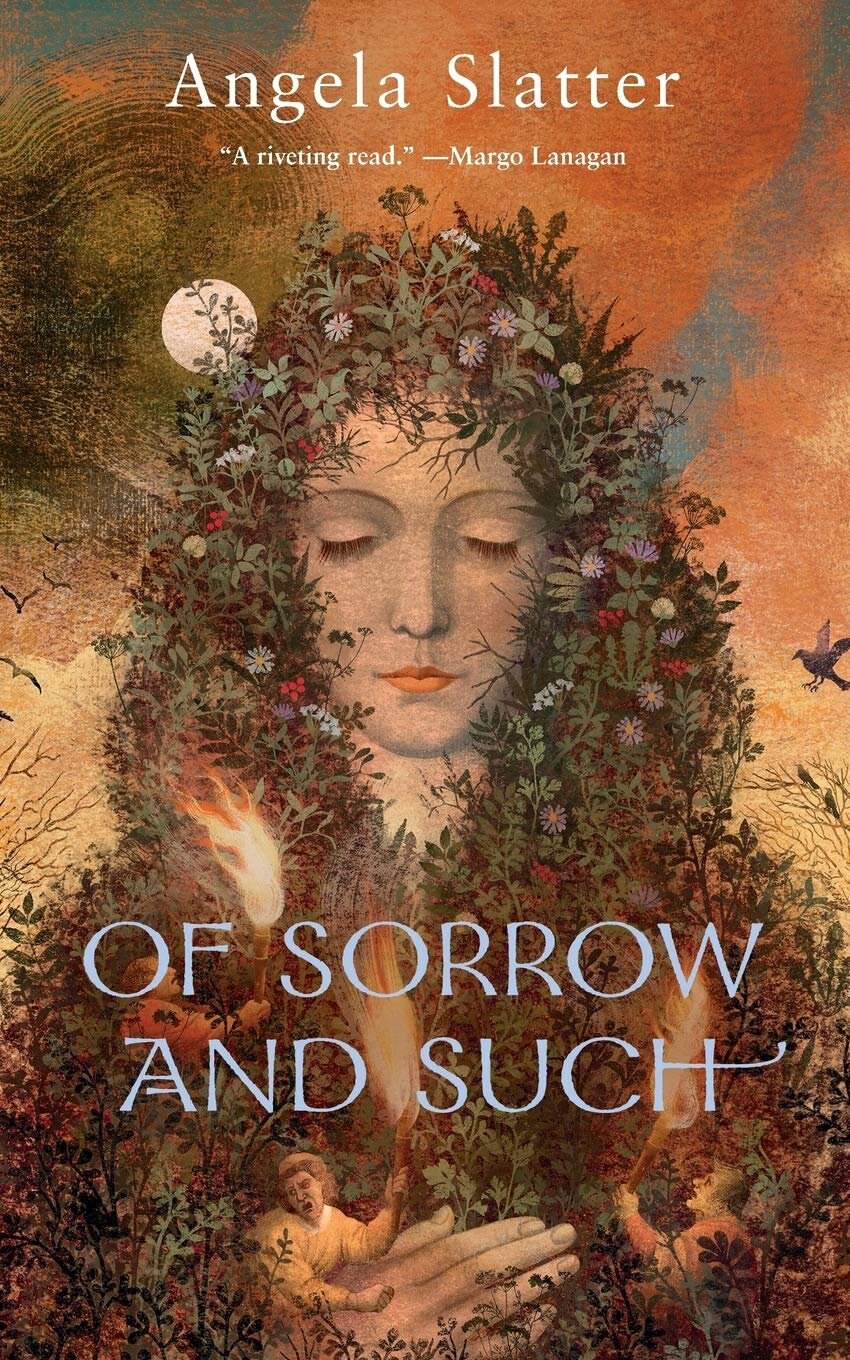
My entrance into this dark and magical time began with Angela Slatter’s novella, Of Sorrow and Such, filled with witches and shifters and fierce females.
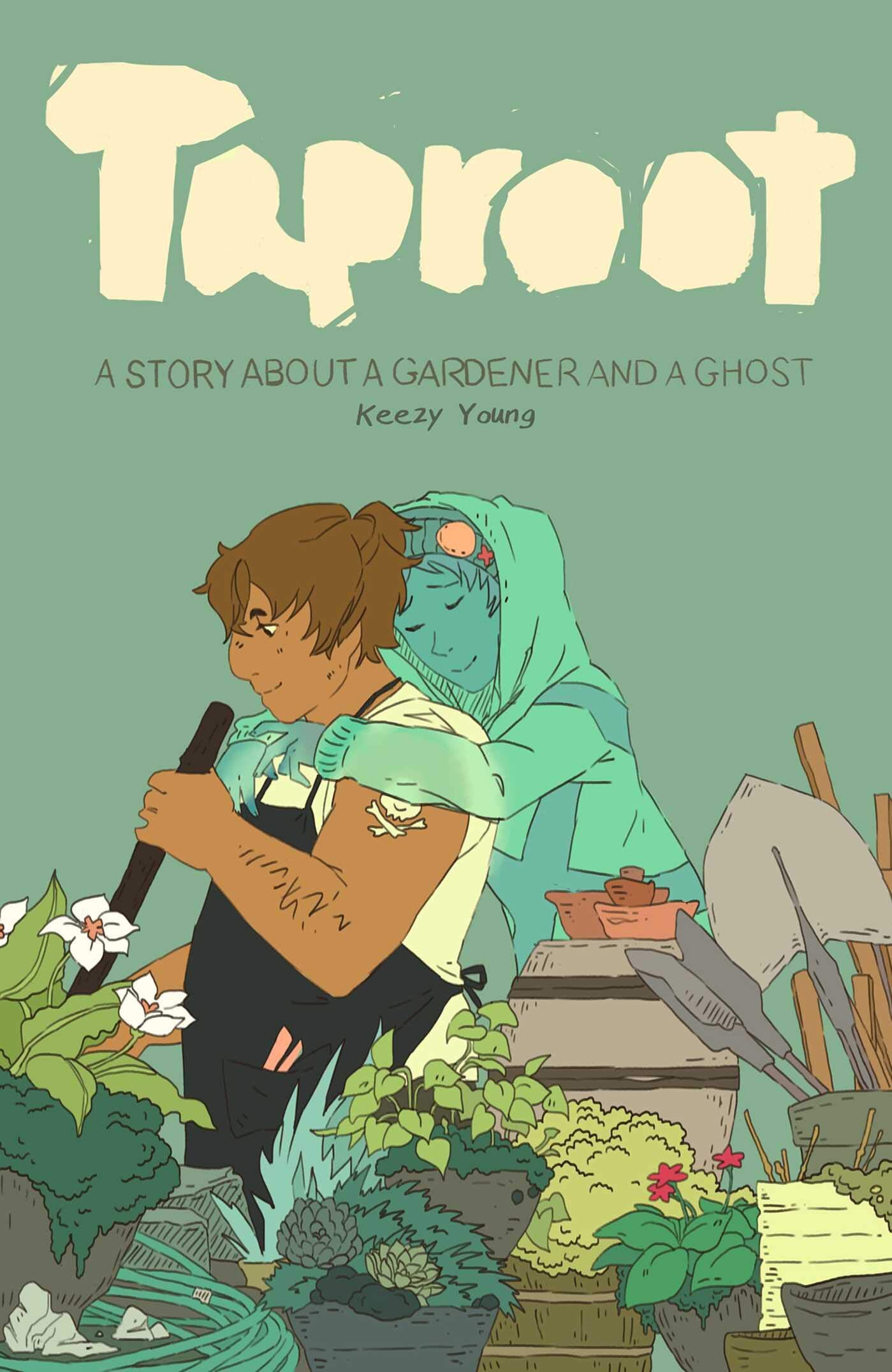
Next up, I read Keezy Young’s graphic novel, Taproot. This was adorable and haunting and broke my heart, leaving me in tears.
To follow, I finished rereading City of Ghosts by Victoria Schwab to prepare for the third book in the series. It was just as creepy and heartwarming as the first time I encountered the story.
The fourth book I’ve finished so far, Raven Girl, offered a modern fairytale filled with transformation, obsession, and true love. It was haunting and immersive, paired with Audrey Niffenegger’s paintings and etchings.
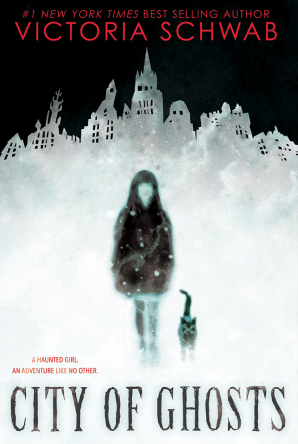
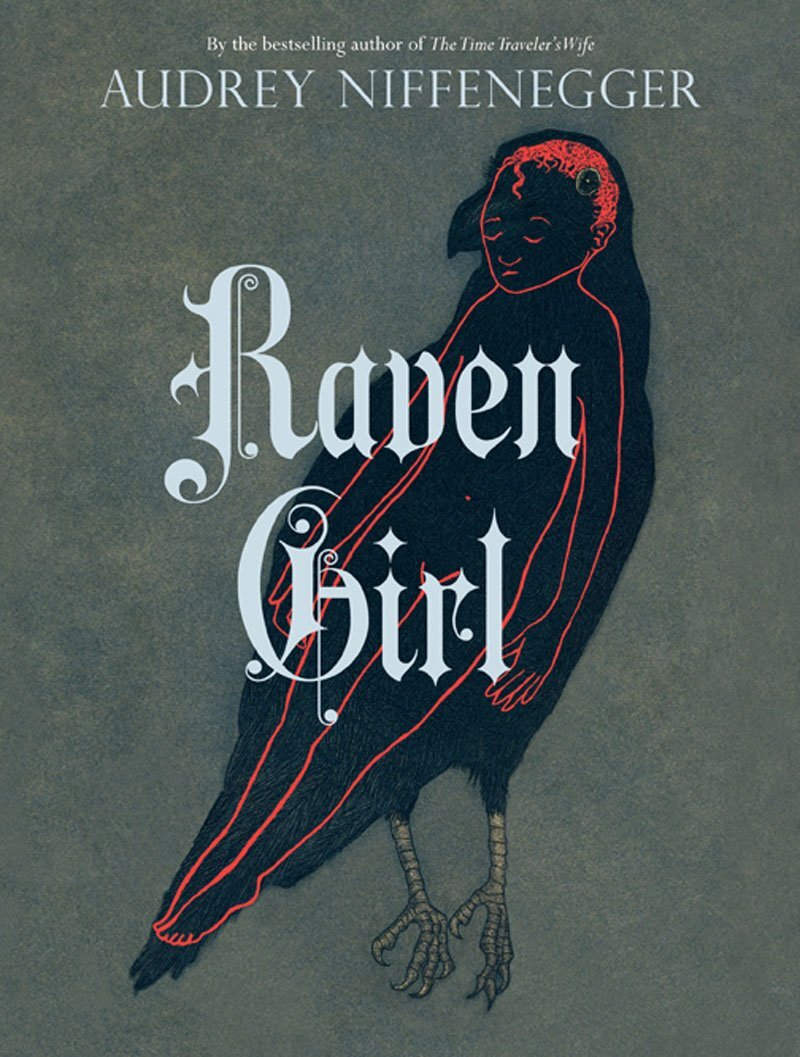
As I journey through this bewitching time of year, I will be sharing my thoughts with you, dear reader. Maybe you’re like me, ready for crisp leaves and spiced tea. Or maybe you’re unsure where to start with so many spooks and haunts available to entertain you. Don’t worry, I won’t let you venture into these spooktacular stories alone. We all know what happens when people split up in these kind of stories. If spooky books aren't for you, I hope you find something to remind you that stories hold magic.
Until next time, happy reading!

Something True: An Author Interview
Upon compiling advice to young writers, I wondered what wisdom those youthful storytellers might be able to share. The search for such a person was not difficult, as one of the most dedicated writers I know happens to be younger than most.

Meeting at Lock Keeper, the namesake for our writing group, proved to be the perfect place for this interview. Keep reading for a behind-the-scenes look at the writing life of Uriah Allis!
When did you know you wanted to be a storyteller?
Prior to telling stories on paper, I told them in my head. This mostly involved me being Peter Pan or Spider-Man. There are pictures of kindergarten-era Uriah in a Spider-Man costume poised on our roof in that iconic pose like Tobey Maguire, who was my Spider-Man growing up.

One day, when I was about five, my mom was upstairs and heard this huge bang. Downstairs, she found an enormous circular crack in our drywall. Of course she asked me what happened. In complete seriousness, I explained: “Mom, an elephant walked through the living room, kicked the wall, and then walked out.” She started laughing. That might be the earliest moment when looking back, I can say, oh, I’ve been a storyteller for a long time. (Just to clarify, no elephant came through the house. I was likely Spider-Man climbing the wall and finding the task beyond my human abilities.)
It’s interesting you say “storyteller.” I didn’t have a television in my house until I was fourteen. I read books, listened to audiobooks, and told my own stories. It was my way of processing my role in the world.
Perhaps I’m giving human beings too much credit, but it seems our way of interfacing with reality encourages telling ourselves stories about the world as it exists, about how it could be, and how it should be. In that sense, we’re all storytellers. It just takes a certain kind of person and/or set of circumstances to share those stories.
Stories are a safe way to make sense of ourselves and life itself. It can be very scary in “real life” to make mistakes you might otherwise avoid by imagining those scenarios through stories. I believe there’s inherent value in doing that from a young age—of asking yourself what ifs. With age, what ifs mature as you grasp a more holistic view of the world. You meet people and garner experiences. You see human patterns of behavior repeat. At the end of the day, we have a choice to stand in the midst of it all and realize, wow, this is an extraordinary maze in which I’ve found myself—this horrifying, beautiful, extraordinary, terrifying world.
Knowing that you have a passion for stop motion stories on screen, can you share what inspires you most about this form of storytelling?
Though I didn’t have a television until age fourteen, I discovered many classic animated films by visiting my grandparents’ house. Their VCR rack was a treasure trove that included all the old Disney films and Bob the Builder, which was my introduction to stop motion.
What I value about stop motion is that you can literally see the fingerprint of the artist. In one way or another, I uncover that same human DNA in almost all mediums, apart from some CGI. There’s something magical about that. It at once reveals the artifice of the art while inviting you to see a more holistic picture of not only the art but the artist.
Another example of this motif in stop motion is called, in the industry, “chatter.” This describes the micro-movements of a puppet designed with hair or fur. You’ll notice the fibers move from frame to frame. It reminds you that an animator must reposition those puppets between every single shot.
Those examples from stop motion all add another layer of humanity to the art in question. In the same way, as a child I loved the art in Peanuts by Charles Schultz. Interestingly enough, my favorite cartoons are the ones he illustrated after having a stroke. His fine motor movements became limited, almost parkinsonian, resulting in illustrations that are “jagged.”
What I love about those jagged lines is they remind you there is no ideal “perfect”—either in art or life. I believe it’s our responsibility as humans to open our eyes to the beauty in the world. Often that can only come through accepting something as a whole. That includes the artifice and broken bits.
Art criticism is complicated; art is created by imperfect people. Nevertheless, the art itself—sometimes heightened by problematic elements—can provide a wonderful human reflection to consider and ask, what is here for me?
As you were not always a self-proclaimed poet, when did you begin to immerse yourself in this world?
It was only in January of this year, 2021. That was after my first semester of nursing school, which was extraordinarily stressful on many fronts.
Over my winter break, I decided to carve out time to explore new things. In writerly terms, I chose to set wider margins for my life—spaces where I could find respite from the constant doing of life.
During that break, I visited my cousin. We intended to visit an ice rink because she adores ice-skating. Unfortunately, the ice rink was closed, so we decided to visit Barnes & Noble. With my new “wider margins” philosophy in mind, I waltzed into the poetry section and found Rupi Kaur’s poems. I devoured her first collection, milk and honey, in thirty minutes.
Until that point, I viewed the ability to read and write poetry as an ethereal gift the gods give to a select few. What struck me about Rupi Kaur’s poetry was just how accessible it is without sacrificing any of its emotional or thematic integrity.
I felt like her poems simply said, here is my soul. The vulnerability she exemplifies in milk and honey and her subsequent collections is incredibly striking.
From that moment in Barnes & Noble, I knew poetry was not only something I wanted to be part of, but realized, I’m already a part of this. I just need to write down my experiences.
Shortly thereafter, I discovered Sharon Olds’s poetry. I was inspired by how she discussed complicated relationships and traumas she survived in such a frank yet tender manner.
Both Rupi Kaur and Sharon Olds showed me the potential poetry has to create what may be likened to taking a Polaroid of an emotional landscape. More than any other medium, poetry can capture the subjective experience of being human in relatable snapshots that would be diminished by recounting objective facts. Poetry can lift you up in a way that goes beyond words.
While discovering this fresh world of poetry, I began to write my own poems. Early on, I was insecure about the quality of my work. I shared my poetry with two people: you and Amanda, a mutual friend of ours. The feedback and encouragement you both provided was very heartening.
My only goal in writing poetry was to be as honest and vulnerable as possible. Frankly, my standard for poetry has not changed. There is no mathematical equation—in terms of rhyme and meter—that equates to a “good poem.” My only parameter is that everything I write must be honest, visceral, emotional, and true.
Poets have to bring themselves to the page. That can be painful. You must strip away your defense mechanisms. Only then can you see yourself as you are.
I imagine that’s why my poems often come to me when I am meditating. I am as vulnerable to myself as I can be at that time. Poetry has the power to capture those moments, giving it a magnetism that draws me as no other medium does.
Kayla King: What I love about modern poetry is the approachability, which I hear when you speak about your first reading experience with Rupi Kaur’s work. This kind of poetry presents an invitation, calling you in, and then breaking your heart. As humans, we find ourselves addicted to tragedy and heartbreak, in part because those emotions are so deeply ingrained in us. Seeing that another person has experienced something similar and found a way to work through, allows us to move forward in a way we might not have without those words. This is something I continue to admire in your poetry, so raw and honest.
If the modern age of Instagram poets and social media taught us anything, it’s that we can very quickly put something out in the world. It might seem less intimate than a relationship with another person, but sharing words without knowing what’s going to come back, saying, this is who I am at the deepest roots of self, there’s power in that.
Uriah Allis: I agree. There is something that creates a sense of triumph when you read a resonate poem. Poetry can grapple with profound realities we face in our everyday lives, yet rarely confront—life, death, and love. Poetry gives us a safe space to process and talk about these concepts not only in broad terms, but in their minutia.
The mere fact that a poet made it through the experiences they’re writing about, that someone else saw it, published their work, and somehow it reached us—the readers—is powerful. Although the lives of many poets ended in tragedy, that doesn’t mean their poetry will catalyze tragedy for others. It can mean quite the opposite. Poetry can allow us to recognize our own tragedy, and reconcile with it.
KK: In a sense, poetry is the most human form of writing. Poems don’t have to be any one thing. Unlike typical novels where we can pinpoint a beginning, middle, and end, there is no need to be linear. The poems that strike me most are often a random collection of images from points in the author’s life that add up to something magical. Similarly, life is a random collection of moments that make us who we are. This stuns me time and again, and I’ve found those points in your poetry as well.
UA: I appreciate that, thank you. To add on, we may not only be inherent storytellers, but also the inherent story.
I’m not a believer in a finitely tuned timeline to humanity in which we are cogs in a system and there is a fate we are all headed for. Rather, as you say, I believe we are like pinballs in a pinball machine. Stories are a wonderful way to conceptualize the many random—or seemingly random—events in our lives. Stories allow us to see the gradations of beauty along the way.
I’m not even sure it’s about searching for some conclusive meaning at the roots of our lives. We seem to designate those meanings as we try to make sense of life. That’s what I mean by saying it’s almost a self-imposed responsibility to tell stories.
Stories also give us reason to believe the world needs to make sense. I doubt other animals are the same way. (That said, maybe I’m not giving dolphins enough credit.)
Weirdly, humans believe there needs to be a genie in the bottle. The truth may be far less tantalizing: a factory may process the glass; distillery workers might pour an alcoholic spirit into the finished container; the bottle could be lost in an ocean and wash up on shore.
Through that lens, many of our stories might try to make sense out of broken glass. But we believe there needs to be something deeper.
I think that says more about us than anything else.
While you touched on utilizing meditation while writing poetry, does your process for writing differ for fiction?
With fiction, I feel it’s necessary to just get words on the page. Whether or not those words become anything is what revision is for.
Regarding poetry, I don’t put that same pressure on myself. I don’t plan to write poetry. Rather, poetry really does come to me out of the ether. Sometimes it goes somewhere. Sometimes it doesn’t.
However, I see false starts in poetry as valuable. I often find there’s something deeper I’m trying to get at. After writing one or two false starts, I usually stumble upon what I’ve been searching for the whole time.
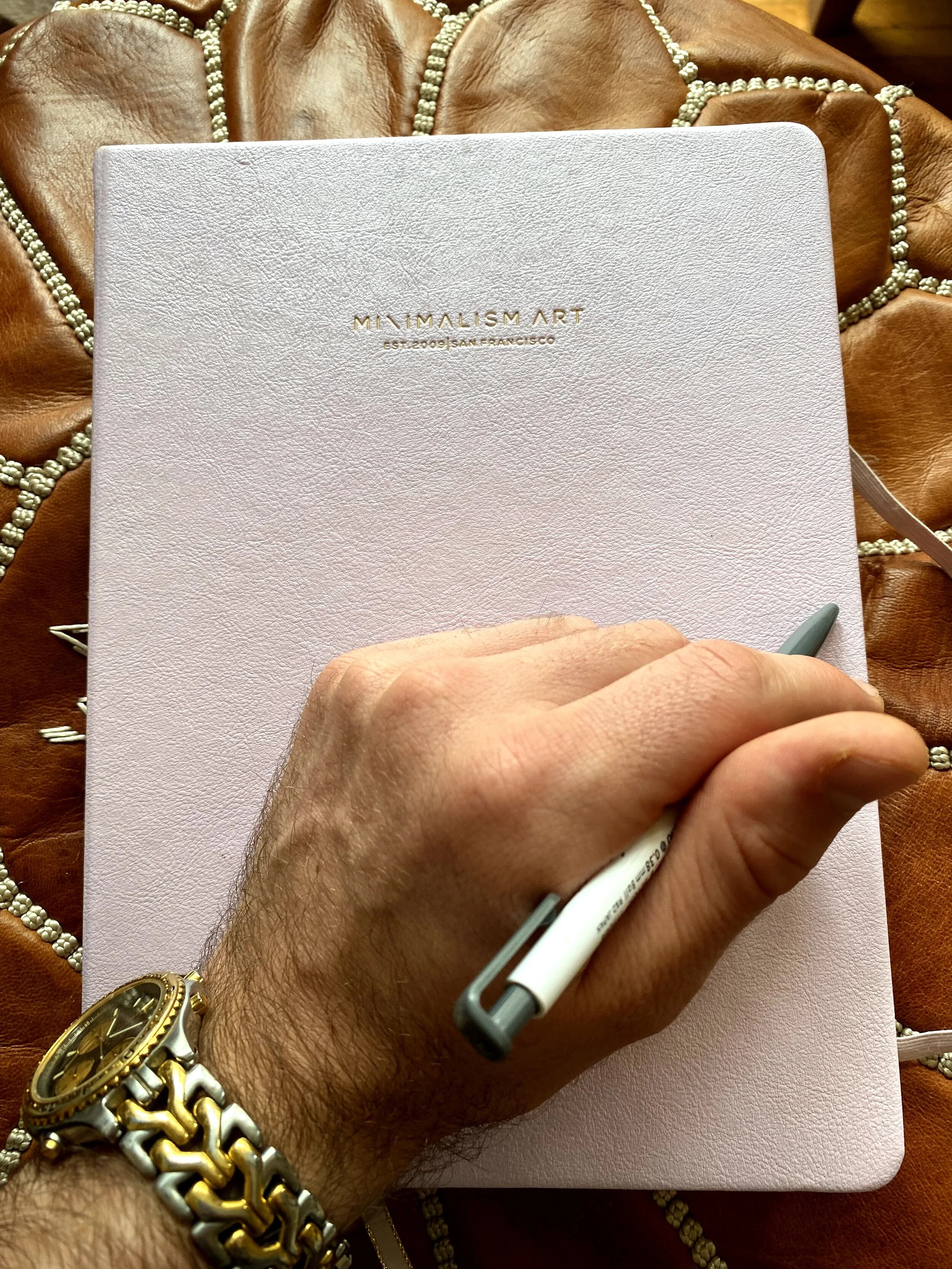
As far as my process goes, I write freehand in my hardback Minimalism Art notebook.
Before I wrote poetry, I decided to try my best to keep from compartmentalizing my life. I reflect this in my notebook—you’ll find writing in it for nursing, journaling, writer’s group, fiction, and poetry. When it comes to creativity, I find it valuable to take in the whole of your life to create inclusive and honest art.
I write in several different colors, usually with G2 gel pens. In my first drafts, you’ll notice a lot of scribbling, illegible lines, strike-throughs, and so on. I’m a messy writer.

For instance, in my poem “fireflies” —which won first place in a poetry competition my college put on—I circled the second line and drew an arrow to denote it should be the last line.
One rule for myself comes from something I first heard Billy Collins talk about. He purely revises his poetry for what he calls “sound pleasures.” I only revise my poetry for phonetic readability. I don’t alter the original intent or theme of the poem.
If you were to Candid Camera my process for drafting a poem, you would probably find me doing a menial task like washing dishes or folding laundry. By doing something that doesn’t involve a lot of thought, I can allow my mind to wander. Then poems come to me. You might call it the “Bugs Bunny effect”: my ears perk up, I dash to my room, pull out my notebook, and write down my ideas.
Have there been any recent books or poems you’ve read that have stood out?

Over this summer, I went on a Civil War history tour of battlefields on the East Coast. During my trip, I visited a bookstore in Fredericksburg, VA, called Riverby Books. There I found a beautiful poetry collection called Conversations During Sleep by Michele Wolf.
There’s a handwritten message on the front cover from the poet encouraging the reader to “keep writing those beautiful poems.” It felt like inheriting my responsibility as a poet: to tell the truth.
I know you have a book with important postcards left by the original owner. Those details in secondhand books add a history to the paper and ink in our hands.

In Conversations During Sleep, there’s a poem called, “Response to a Reading.” In it, Michele Wolf critiques two poems that quite unsettlingly portray sex with the undertones of sexual assault.
What struck me about Michele Wolf’s poem was her approach to critiquing this very disconcerting language. She uses such gentle rhetoric to draw a line and say, this is very fucked up.
That poem reminds me poetry has the power to take issues that can become so emotionally charged that no productive conversation is able to develop around them. Poetry finds a way to cut straight to the human heart. I believe it is the perfect vessel to circumnavigate the political divides we face. It allows us to discuss timeworn, problematic, patriarchal ideals especially prevalent in this country.
Michele Wolf reminds me that poetry is a brilliant mode of self-reflection—not only on one’s own beliefs and perspective, but on how one’s beliefs and perspective are born out of the culture we grow up in. It can make something that is otherwise inaccessible quite accessible, something that is otherwise taboo no longer so.
One thing I love most about poetry is the ability to access things that are understandably uncomfortable, personal, intimate, and often hard to talk about. Yet, it can do this in a way that opens up the heart as well as the mind.
What is your favorite thing you've written within the last year? It doesn’t have to be a fully finished piece. It can be a sentence or paragraph from your work-in-progress.
My favorite thing I’ve written in the past year is undoubtedly the ending to a poem called “the butterfly affect.” It was recently accepted by Eclipse Magazine. Very rarely do I write a line I repeat to myself every so often afterwards. This was the exception.
To set up the poem, “the butterfly affect” portrays the metaphor of metamorphosis—the transformation of a chrysalis into a butterfly—as possessing more than superficial beauty.
The last line is:
in the butterfly,
i find my delivery:
the violence of many things
broken together,
sprouting wings

When I wrote that line, it took my breath away.
Those words, after I wrote them, suddenly encapsulated my adult experience of interfacing with myself. They claimed the importance of accepting all the broken and hurting bits of my personhood—not as an ending point but as a diving board into a new and more glorious existence which is the present tense.
Editor’s Note: I will convince Uriah to put this quote on stickers, tote bags, etc. so everyone can be reminded of this daily.
If you could give advice to your younger self, what would you say?
I look back on my younger years and realize I put so much pressure on myself to be “something.” I wish I had just taken a moment to look at myself in the mirror and say, you already are something.

Rather than striving for some sort of abstract ideal called “success,” I would tell myself, if you can’t accept who you are as a whole—the good, the bad, and the in-between—you’ll never grow.
I would say: be kind to yourself on many fronts, and give yourself time to figure things out. Don’t fall into the trap of thinking you need to know the answers because, more often than not, the questions are far more enlightening than the answers.
If you could provide any advice to fellow young writers, what would you say?
The advice I heard growing up was, “Read a lot. Write a lot.”
At fourteen, I heard Brad Bird who directed The Incredibles and Ratatouille say, “Make me care. Take me on a journey.”
As for my advice, I would say give yourself time to shear away the dark matter around yourself to reveal the diamond that is your soul. It takes time to carve a diamond from a mountain.
Do you have a specific playlist for writing?
I do! Curiously, music occupies a different emotional space for me depending on whether I’m writing fiction or poetry.
For fiction, I usually listen to an instrumental soundtrack in its entirety. I love the composer
Max Richter, who composed the soundtracks for My Brilliant Friend and The Leftovers (not to mention his extraordinary work in the neoclassical genre). Other favorites include: Rupert Gregson-Williams, Ramin Djawadi, and Nicholas Britell.
When it comes to poetry, I listen to one song—usually with lyrics—on repeat. If a song resonates deeply in my soul and I can feel it there, almost palpably, that’s what I’ll play.
I really like Radiohead. My earlier poems especially featured a Radiohead-themed soundscape. One song of theirs that made appearances in poetry writing sessions is called “Give Up the Ghost.” It has a repeated refrain: “Don’t hurt me / Don’t haunt me.” What resonated with me in that song was the idea that the singer is haunted by the narrative of someone hurting them—and gives that narrative the power to hurt them—rather than actively being afflicted by a person or situation.
Another song I found very moving is “The Rip” by Portishead. I remember sharing it with you shortly after discovering it. That one resonates largely because the lyrics are so poetic and the vocalist, Beth Gibbons, sings every note as if her heart is breaking.
If you were to sneak a look at my Spotify selections, you’d know I’m a fan of jazz, classical music, Broadway musicals, ‘90s rock, and “prog rock,” although that word sounds so pretentious. In the end, what matters most is the emotional resonance of my music preferences. I believe some of my best work is born from emotion roused in me by songs.
As someone who has found a writing group, can you share why you sought one out in the first place?
At age eighteen, in early 2019, I watched the movie Taxi Driver. It disturbed me, as it should. One thing it does well is show us who we can be at the darkest moments in our lives.
The story of Travis Bickel is of an individual who has fallen about as low as he possibly can. He’s someone who had many struggles and could have sought help, but never did. Thus, he became increasingly isolated from others and increasingly taken with his own mental illness.
I lost sleep over that story because I realized, at that moment in my life, I had no friends. However, I had not taken the initiative to meet new people.
After that, I decided to seek people who I could connect with and trust, understand and care about. I wanted to find creative people who I could share a sense of mutual reciprocity with and cultivate genuine respect for.

That led me to discovering the site Meetup, which is how I found local writer’s groups. Through that, I met you and several of the individuals in our current group.
It took you being there and the universe, so to speak, arranging our meeting to find everything I was looking for.
I look back and am tremendously grateful. I can share the deepest, most vulnerable parts of myself through art and conversation—even beyond critiquing each other’s work. Together, we can find companionship and a sense of belonging in this world.
That’s why I like stories that are uncomfortable: because they force you to think deeply about yourself. If it hadn’t been for a movie as fucked up as Taxi Driver, I doubt I would have sought out you lovely individuals who have become very, very dear to me.
KK: The feeling is entirely mutual. It’s interesting to note that I think we were both in darker points of life before we met one another. I’ve mentioned February 2019 being the darkest point in my life and not actively doing anything to remedy the situation. I realized I had incredible people in my life as far as family and best friends, but nobody who was actively writing. After being in the Mountainview MFA program, I missed the support and growth I’d found with other writers. I wanted to feel understood. This is why I downloaded the Meetup app, only to find our writing group. It wasn’t until the second meeting that I met you, but from then on, I felt understood. To make a long and lovely story short, thank you for existing, Uriah.
UA: Aww! Thank you! The feeling is mutual. The first time I read something you wrote, I was just like, oh my god! It wasn’t even Dream Catchers, your work-in-progress. It was “the feather story.” What is the title of that piece?
KK: “How to Bind a Lover, or the Lingering Aubade of Lear Aldrich.”
UA: I went to our first meeting not knowing what to expect. I was so impressed by your work. I deeply wanted to impress you and everyone else by “bringing it” in terms of my ability to critique.
KK: You brought it.
UA: I tried. There was nothing I could say about that piece—or much of your writing, honestly—that felt particularly constructive. Mostly I was just like, this is amazing.
KK: Reader, the first piece Uriah brought was a story about a daughter, so lovely and heartbreaking and complicated, which encompassed reincarnation if I’m remembering correctly. It seemed to be written by somebody who’d lived 200 years. I assumed Uriah was much closer in age to myself at the time, 26 or so. He was 19, but possessed so much eloquence and passion for writing. It was an infectious energy loved by everyone, myself included, and that hasn’t faded. Uriah, thank you for caring so deeply about life and language and myth and stories. You inspire me everyday.
Can you share the benefits to being part of a writing group?
Being in a writer’s group gives me the sense I’m not doing this alone. Writing is a solitary profession—you’re usually by yourself with a blank page or laptop. But being in our writer’s group reminds me of the grand tradition of storytelling and storytellers.
I believe there is inherent value in that tradition. It recalls images of the lore master sitting around the community fire long ago. The villagers gathered near the flames to stay warm, but also to hear stories of places that are far away and to empathize with strangers who may only exist in fiction. These tales give us all something to think about as we go to sleep, and, when we’re asleep, they give us dreams to dream.
In short, our writer’s group gives me a sense of community, belonging, and purpose.
KK: This brings to mind the quote from Gene Wilder’s portrayal of Willy Wonka. He says “we are the dreamers of dreams,” which comes from Arthur O'Shaughnessy’s poem “Ode.” The stories I gravitate toward possess this notion of collective dreaming and storytelling, where ideas continue to be reimagined. It’s easy to trace this lineage from Orpheus and Eurydice to Laura Ruby’s Bone Gap, effused with elements of lyricism, myth, and going through darkness to bring someone home. Neil Gaiman has often said Orpheus plays a role in his storytelling. This is most clear in a line from “Sonnet.” Then there is The Wicker King by Kayla Ancrum, a formidable unraveling of the human psyche filled with obsession, myth-making, and human resilience. We keep telling the same stories because we try to make sense of the unknowable: love and life and death. Then I see my novel, Dream Catchers, built from the embers of all these stories I’ve loved, and it’s hard to argue against their power.
UA: And those threads not only create stories, but also weave the grand tapestry of our lives.
When did you decide to pursue publication for your work?
It was when you inspired me to do so, Kayla.
One of the first conversations we had involved you telling me you had received about one hundred rejections that year alone. My thoughts were, firstly, oh my god, that sounds horribly painful, and, secondly, I applaud you for putting yourself out there in that way!
After writing several poems, my feeling was that if the poetry I read was speaking to me in such a deep way, I wanted to share my poetry with the hope that others might resonate with it. This is not to sound pretentious. But in the same way I can pick up Rupi Kaur’s poetry and find something that rings true, my belief is that if my poetry can connect with anybody else, I want to pay it forward.
That’s one of the best elements about the poetry community: there’s a sense of “passing the torch.” Little ego is involved. All that matters is saying something true.
Unfortunately, I don’t think that same altruism exists in the fiction-writing community. With fiction publishing, there seem to be gatekeepers rather than individuals willing to pass the torch.
In the poetry world, there are wonderful editors who are interested in reading the work of those who decide to submit. That doesn’t mean you’ll be accepted. However, it’s not about the acceptance—it’s about the mere fact that you’re part of this community and truth-seeking tradition.
KK: While not all editors are built the same, knowing your recent publication experience, it’s heartening to know there are editors willing to say, we really love this, we think it could be just slightly better, and here are some reasons why. I want to be the best editor, but as a writer, I appreciate a community interested in publishing quality work, even if it takes a little extra finesse to get there.
UA: I love that. I think you’re an exemplary editor in that regard. You focus on what the art needs. It’s not an ego-boosting trip.
Editing should always be about making great art. Your ability to do that is inspiring and so pure. I just wish we could clone you all across the creative industries. The world would be a better place.
What is your process for receiving a rejection? How do you move forward? How do you process this redirection?
I have been rejected many times at this point. The first rejection I received was actually heartening.
The first step is to look at a rejection and realize that somebody cares enough to read your work. It’s not about looking for the silver lining, but recognizing that all we have is silver lining! We are living in a world where people are interested in reading and writing poetry—a world where poetry is still valued.
The second step is to accept the rejection for what it is and no more: it merely means this journal or magazine isn’t the best home for the pieces you submitted at that time. A rejection isn’t a comment on you as a person, nor as an artist, nor even on the work itself.
The third step is to know that, although one door is closed, you might find another one. Regarding the current climate surrounding online publishing, there are so many avenues showcasing diverse work. Thus, to process redirection, I recommend finding a new place to submit your work so long as you still believe in it.
Rarely have I decided after a rejection that I don’t want to submit to another publication. That has only happened once or twice. Those instances are not because I felt discouraged, but because I sense the work is only half-baked. I put those pieces on the shelf and decided I might come back and revise them someday.
On the flip side, you do need (earned) confidence in your work. For instance, I wrote a poem I’m still sending out for publication called “heartbr[ache].” Several publications rejected it without any comment on the poem itself. I don’t think that’s a mark of the work’s integrity. It means it wasn’t for them.
“heartbr[ache]” emerged from a dream of mine involving a couple I know who were getting divorced. In my dream, the suits and dresses from their wedding were being sold at a yard sale outside of their house. I feel like like I capture that sentiment well in my poem.
I’m going to keep submitting “heartbr[ache]” until it'’s accepted because that dream still haunts me.
Are there any writers who inspire you to keep pursuing this passion?
I really appreciate Neil Gaiman. He’s humble, and he puts himself out there. I greatly respect how he dabbles in many mediums while remaining true to himself.
KK: Neil Gaiman was actually the first person who came to mind when I considered what my answer might be to this question. He crafts the darkest of stories, many for kids, and makes no apologies. His writing teaches us that you can beat back the darkness with light, whether it be overcoming your Other Mother or ridding yourself of an otherworldly worm intent on evil. He reminds us the world is not a perfect place. Sometimes, in fact, it is a scary place, but there are people who become heroes. They triumph over their monsters.
UA: As far as other artists go, I’ll add Rupi Kaur to the list. She’s extraordinary.

I admire how gracefully she approached a situation that became rather controversial regarding her work on Instagram. On the platform, she shared a wonderful selection of photographs of her bed after she had her period. Her photographs were such a brave exploration of vulnerability through art. They were initially banned by Instagram, only to be later uncensored. They opened a much-needed conversation surrounding censorship, especially around gender. It asked questions I consider constantly as a nursing student, poet, and fundamental human being: What does it say about our culture that we cannot reconcile with the reality of what is to be a woman in a woman’s body? How can we live in a world where women are expected to be more than human, yet are treated with standards that are subhuman?
Additionally, I adore anything by Margaret Atwood.
KK: Whether it be Atwood’s poetry or fiction, she tackles terrifying concepts. Her words scare us because they’re true. We look at The Handmaid’s Tale as a novel, published in a time when the world was stricken with arguments about the rights of women. Today, we’re still having these conversations. In much the same way that Hulu’s adaptation of the novel shows June moving season after season toward a life of freedom, so too have we seen incremental changes in our own world.
What dystopian literature and Atwood especially do so well, is packaging trauma under the guise of fiction. We think we’re only reading a book, but the story begs us to stop and reevaluate. Those stories plead with readers to avoid making similar mistakes. Storytelling continues to be the cure all. It’s seeing the sameness from Gilead in the proposed Bounty Law in Texas and hoping we might find a better future. It’s about putting pen to the page, no longer hoping for a better world, but saying, I’m going to try to find a way to say something important with my art.
UA: I absolutely agree. Something else I appreciate about Atwood and Gaiman is their openness to discussing the art and craft of writing in a way that demystifies it and makes it accessible. They also give me hope by seeing how relatively well-adjusted and kind they are as people, in addition to being brilliant artists. Those two characteristics are not diametrically opposed.
As someone pursuing another career, what is the importance of a day job?
I genuinely love nursing. I am so grateful to care for every single one of my patients, and to work with doctors, technicians, nurses, and every other member of the multidisciplinary team. At a foundational level, in regards to the importance of a day job for a writer, we live in a capitalistic society. For those of us who are working class, we need to make ends meet.
After earning my Registered Nursing degree, I would like to take a screenshot of a text I sent you shortly after I met you. I asked what your thoughts were on nursing as a career in tandem with creative writing.
KK: I’m so happy that you included me.
UA: I saw something in you early-on I could trust.
Having a day job also takes a pressure off of your art to be financially successful, which is better for both your art and your own mental health. Further, a day job offers not only financial support but also the opportunity to meet people and have experiences you otherwise might never have.
I’m cautious about approaching life as simply a means to an end for a writer—as an inkwell from which to pen stories. I am a huge proponent of finding beauty in the present, no matter where you are or what you’re doing. That includes my job.
As a nursing student, my career provides me with a wonderful wealth of knowledge and competence surrounding the human experience, including the mind, body, and spirit. It also gives me license to care for those who are hurting and in need, which is deeply important to me.
If you could see into the future ten years from now, what would life as a writer look like?
Hopefully it would look like it does now, frankly. At least in terms of my quality of life as an artist, I am quite pleased with the emotional gratification and spiritual satisfaction I find in my art.
If you cannot find satisfaction in what your creative life looks like in the present, I imagine your satisfaction won’t magically appear in the future. I say this not to bring down the mood. On the contrary, my belief is that anyone can find at least some satisfaction in the here and now.
You’re always going to have time constraints and life situations that make it difficult to find the time to write. The key is to do what you can now, without sacrificing your mental health.
With that said, I would love to write and direct for television and/or film. Given the opportunity, I would be honored to adapt work for television—either my own or the work of my dear friends, such as your work, especially Dream Catchers.
KK: A Dream Catchers adaptation for Hulu or HBO would be very interesting.
UA: I already have a certain setlist in my mind: ethereal, 2000s and 2010s era indie pop with a few standout anthems from the ‘40s, ‘50s, and ‘60s, such as those by artists like Ella Fitzgerald and Chet Baker—songs such as “Dream A Little Dream of Me” and “A Kiss to Build a Dream On.” The trick would be to refrain from being too on-the-nose.
I think in a very cinematic way, and I’d love to play with color in a Dream Catchers adaptation—shades of whites and blues, contrasting organic browns, greens, and yellows with artificial light and darkness.
Going back to your initial question, in ten years I’d love to have a few collections of poetry and perhaps a couple books of fiction published.
Recently, I’ve been pondering life as a “creative” versus a “person who created something.” I’d like to live the life of the former. For me, that looks like seeing in a way where I cannot easily separate living life through a creative fashion versus a non-creative fashion.
With that said, if no one ever knows my name as a writer, but remembers me as a good person who made a positive impact on their life, I will be more than humbled and grateful.
KK: Ten years from now I expect there will be more than one of your books on my shelf.
And you would be the perfect person to tackle the adaptation of Dream Catchers. This fictional world is so delicate and vulnerable. But from the beginning, you’ve championed the darkness and the tough chapters because you understood how important this narrative could be to others. There are not enough thanks to adequately show my gratitude for your encouragement and understanding.
UA: Thank you, Kayla. I sincerely appreciate that.
The approach to filmmaking I want to take is one that prioritizes the working environment and mental health of everyone involved, especially the actors. For me, this is the perfect intersection of my passion for nursing and for storytelling.
I firmly believe one can both maintain their mental health and create great art. You can portray darkness without allowing it to swallow you.
Regarding Dream Catchers, which heavily deals with the subject matter of mental illness, this approach would be even more important.
What I’d would love most is to sit down with the young woman who is cast as your lead character and engage in deep conversations surrounding who this character is; what the subjective experience of having obsessive compulsive disorder can be; and how we as artists can maintain our mental health while bringing such a character to life.
Overall, I’m interested in creating a healthy environment on (and off) set while cultivating great art.
KK: This reminds me of an interview with Sarah Paulson after the second season of American Horror Story. She explained that when you go through terrible things, even as an actor, your body doesn’t know you’re just playing pretend. Often what follows is PTSD, your body going through the motions of processing trauma. The Asylum season focused on kidnapping and sexual assault for her character, and the physicality of these events left lasting impressions. We can’t trick our bodies by saying, this isn’t real, so it’s okay.
The same can be said for Ben Platt in his portrayal of the title character in Dear Evan Hansen. He built in certain ticks to the characterization and then struggled to untangle them from his actual personality once he left the stage production.
UA: Ben Platt, from my understanding, worked with an occupational therapist for a while after that production to regain his mobility.
To fly right into the teeth of this subject, I’ve read studies that suggest there is a much higher incidence of individuals with mental illnesses employed in the creative industries than in other industries. It is imperative to tend to our mental health as artists in this industry.
In the same way that Maggie Gyllenhaal, with HBO’s The Deuce, was an early advocate for the role of an intimacy coordinator to keep actors safe and comfortable during sex scenes, I would love to help introduce an industry standard regarding the preservation of our mental health.
Is there anything else you'd like to share?
I’d like to impart the importance of giving yourself a“wide margin” in your life, regardless of whether you consider yourself a creative person. Had I not given myself time away from all the doing in my life to rest and explore try new experiences, I would have never found poetry.
Allow yourself to be open to new experiences that are safe and healthy—but experiences nonetheless that might allow you to access parts of your personality you may have not previously tapped into. Hopefully I can continue to do the same for myself.
Thank you for your time, Kayla. This was an honor.

About Uriah Allis
Uriah Howard Allis, a twenty-one-year-old poet and nursing student from rural Western New York, has found pieces of his heart, mind, and soul escaping to the blank page ever since he could hold a pencil.
When he officially reached his “twenties,” he began to gladly slip into rhyme and meter, and whatever lies beyond.
Uriah is the winner of the Alfred C. O’Connell Library’s 20th Student Poetry Contest (2021). His poetry has been published by or is forthcoming from Active Muse, Ice Lolly Review, Eclipse Magazine, Moss Puppy Magazine, and Intangible Magazine.
You can follow his journey on his website or Instagram @uriahallis.
Thank you for sharing, Uriah!

The Write Place
Through the years, I’ve become someone who can write anywhere. I do believe there is a benefit to adaptability when it comes to finding time for words. But there is something to be said about a place dedicated specifically to the craft and growth of writing.

For me, this is my writing cave, which exists in the corner of my room as a sanctuary for stories. Sleep has often been sacrificed to spend time here. Whole worlds have been born from the ether of the universe in this space. I have grown as a writer and a person at this well-worn desk.
I suppose there are places that feel more comfortable than others because they allow us to be exactly as we are. Even as the world asks us to be different versions of ourselves daily, there is a magic to finding the you in a space.
However, I must admit this desk and the writing cave disappeared beneath paperwork and books and disorder during the last few months. In that time, I’d forgotten how much I loved this tiny corner of my world. And though we all exist in spaces differently, for myself, I know that a cluttered room leads to a cluttered mind.
I needed my space back. I kept planning to reclaim this corner, but alas, time felt fleeting. While we can and should make plans, sometimes life has different intentions. And as life is wont to do, it threw some disruptions my way, most notably by flooding my closet earlier this month. I didn’t plan for it, but it forced me to clear out and clean up the mess.
This opportunity was the nudge I needed to tackle my writing cave. And now that this space has returned to stillness and solace, capturing its importance here feels necessary.
The space:
As previously mentioned, the writing cave exists in a small corner of my room. It contains my desk, an alcove, a craft stand, and a bookshelf. So what makes this space special?

In part, I think it’s the careful curation of everything that makes me feel connected to stories. It’s history and memories and nostalgia and possibility. Among these treasures, you’ll find antique teacups, vintage books, typewriters, lighthouses, honeybees, pens, planners, and more. Perhaps this is the closest you’ll get, dear reader, to understanding my composition as a writer at the molecular level. This microcosm of personhood remains clear on the days when I feel lost.
The desk:

This is truly one of my favorite finds. In 2014, I wandered into a building near my hometown, which everyone calls The Barn. It is, in fact, a barn filled with items from ceiling to floor with no rhyme or reason. It takes hunting and a keen eye to find treasure. I did just that. I paid $50 for a desk that in perfect condition is worth 20 times this amount.
Alas, my desk is far from perfect. I love it all the more for its scars and history. This antique Limbert Arts and Crafts Library desk was crafted from tiger oak in the mission style during the early 1900s. The drawer has a place for a quill and ink.

Most convenient for an avid reader, this desk provides two sets of shelves on either side. Stored here are more than enough books to fuel my obsession with Grimm’s Fairytales, Greek mythology, and Alice’s Adventures in Wonderland.
The latest addition to the shelves is a canvas print of the Currituck lighthouse, which for those who know the world of my work-in-progress book, DREAM CATCHERS, you know how important this building is to me.
No matter where I go or what story I pursue, I know this desk won’t be far from my journey. We’re kindred spirits, meant to be in each other’s lives for always.
The alcove:
Four years ago, I knew this space needed to be transformed into my writing cave when I saw the alcove built into this corner. You see, dear reader, I’d started my own collection of antique teacups (my great-grandmother collected them first) and I knew this would be the perfect place to showcase them.

And as the years have passed and my collection has grown, my love for these two shelves has not diminished. I’ve added more than just teacups here. There’s vintage editions of Tennyson’s Poetical Works, Euripides, A Wrinkle in Time, Sonnets to Orpheus, Idylls of the King, In Memoriam A.H.H., various works of F. Scott Fitzgerald, Winnie-the-Pooh, The Wind in the Willows, Vanity Fair, vintage writing craft books, the April Poems circa 2020, Far From the Madding Crowd, a first edition collection of poetry by Edna St. Vincent Millay, Paradise Lost, and so many copies of Alice’s Adventures in Wonderland.
A more recent addition to this space is the lighthouse print gifted to me by one of the best friends to celebrate the publication of Pages Penned in Pandemic. Someday, dear reader, you’ll discover why lighthouses are so important to me. For now, I’m still figuring that out for myself.
The craft stand:

For Christmas 2020, my parents gifted me this incredible stand, which now houses my myriad of craft supplies. Whether washi tape or watercolors, I love having the ability to dabble in other creative arts when need be. I’ve utilized the space as much as possible, adding some framed prints of Alice exploring Wonderland (a gift from the other best friend) and some additional teacups!
The bookshelf:

While this is only one of the bookshelves in my room, this one provides so much to love and to feel inspired by when my own words feel more distant than usual.
At the very top, I’ve added some teacups (I now have 37 in total, though I’m starting to run out of room) with my Honeybee Farms sign.
Though the least visually interesting, the binders on the bottom ensure my curated writing throughout the years stays organized. These binders remind me to keep going without giving up. I’ve done it countless times before. I know I can do it again, so long as I try.

As I’m always trying to become the best writer I can be, I find having a collection of craft books to be just as important. This first shelf continues to grow, and so does my passion for my art. To keep myself tethered to where my current work-in-progress began, I keep a framed scrap of paper with an idea that I tied back to Camryn’s story a year after first writing it. It’s something to look back on when the drafts seem endless and the work feels unmanageable.

I know what you’re thinking: what would a bookshelf be without more books? Worry not, dear reader. Below the pens and markers and highlighters is a shelf filled with graphic novels, a beloved quote about brokenness, a beeswax candle shaped into a lighthouse, and a coffee mug with a beautiful origin and characters from a favorite show.
Just below this shelf are books about dreams and mythology and magic with some memoirs for good measure.
The essentials:
No writing cave would be complete without those last few items that make or break a storytelling session. For me, this comes down to eight items. Though water, coffee, and crystals are a MUST, they are not pictured below. The others include:

Macbook Pro
Moleskine journal (current edition adorned with an Ew David sticker)
Archer and Olive Planner
Felix Gray blue light blocking glasses
Headphones
Recently, I’ve been reading back through old blog posts. In doing so, I found one written before I turned 25. And in it, I promised a tour of my writing cave. I realize it’s taken four(ish) years to finally compile this here, but I’m happy I didn’t rush the post. The writing cave has changed, taking on more history and energy and stories than I ever imagined. And I have gone through my own growth since then.
I can’t wait to revisit this years from now in my next writing cave. I imagine it will have even more bookshelves and teacups, that I will still be writing from the same desk, only I will have a view of the ocean from windows that let in the afternoon light. Maybe this is more a dream than anything else, but in case you’re new to this blog, you should know I am a dreamer.
Whether you’re finding yourself out in the world or in a tiny corner of your home, I hope you’re able to be you, whoever that might be.
Your Words Matter: Advice to Young Writers
In life, perhaps the only guarantee we’re given is that time will pass. Minutes move us through the week, a month ends, another begins, and before we know it, it’s been a year.

Even knowing this, it seems impossible that a year has passed since the first Pages Penned in Pandemic interview post went live on this blog. I wrote that post with the hope that I would, at the very least, be able to learn a bit more about my friends and their writing lives. You see, no two writers are the same. Though our writing group connected virtually to share completed work, we weren’t always there for the difficult days, for the selection of the perfect song to help distract from the chaos beyond our windows. And in crafting questions for this interview series, I wanted to know about those things and more.
Early on, my blog schedule was indeed filled by friends. But I took a chance, reaching out to other writers on Twitter, and now I am blessed to have some of them as both friends and champions of my writing. The world is a messy and complicated place sometimes, but there were days during this process when everything aligned and felt too perfect; unreal.

This isn’t to say that the featured blog series or what followed came easily. No dream worth following is ever easy. But the process of putting together Pages Penned in Pandemic was worth it. Now that a year has passed, I can write those words with complete confidence in their truth.
Maybe you’re asking what this has to do with advice to young writers? Well, dear readers, among the questions I crafted for the interview series, I knew I wanted to ask writers what words of wisdom they might pass along. If anyone was impacted most by the pandemic, I thought it was likely the kids and young adults who had a story inside and no one around to encourage putting it on a page.
All these many years later, I am lucky to say I still have teachers inspiring and urging me on toward my other dreams. I knew this was something not to be forgotten or dismissed despite the difficulties of 2020. This is also why all proceeds from the collective are being donated to 826 National, an organization which benefits young writers. But you can read more about that HERE.

For now, I want to return to this advice. The world is still chaotic. We’re all healing and rebuilding and trying to find our way. So whether you’re new to the craft of writing or young at heart, I hope the advice from these 100 authors helps you in some small way.
Advice to young writers:
“Keep writing! "Practice makes perfect" is a cliche because it contains a grain of truth. The best way to improve your writing skills is to write more.”
-Kate Pashby
“Even on the days where it seems difficult, just keep moving. Keep writing, and keep reading. Find a community, whether online or in person, who supports your writing, and be sure to support theirs. Even when you're rejected, remember that it isn't because your writing isn't good, it's just not the right fit for where you submitted it. You'll find the right space for your writing, and it will be a joyous day.”
-Melissa Boles
“It doesn't matter what 'time' it is; keep writing, keep reading, repeat. Others will give up. If you hang in there, someone will find you and your work.”
-Dónal Fogarty
“Keep writing and remember writers have put words to paper in worse pandemics.”
-Ben Nardolilli
“Your words matter! They matter to you - and there's someone out there who needs them, too.”
-jerica taylor
“Write, edit, write, read aloud, edit.”
-paul beckman
“When you can't write, read. When you can't read, write.”
-Megha Nayar
“Make writing a part of your regular routine.”
-Linda Gebroe
“Just keep going—it's never going to be what you expect but really, we've picked an 'industry' where the uncertainty is going to be part of our lives for good so it's best to get used to things like rejection and plans changing and whatnot pretty early on!”
-Rhea Dhanbhoora
“Write all the things you're afraid to write about.”
-J.D. Eames
“I think I'm a "young" writer myself, meaning inexperienced. But what I learned in this time was to write, connect, and submit. The writing is always first, and I've learned to write what I love. Then I've found that by connecting to other poets, I've found tons of support, encouragement and new challenges. Finally, for years as a writer I was so scared of rejection that I didn't submit. This year, I've just fired away at the journals my friends recommend to me. And it's been great to see more of my poems finding homes in the world!”
-Matthew Miller
“Do better than I have. Write everyday. Read everyday.”
-Ted Chiles
“Butt in chair; get into your interior world.”
-Caroline Johnson
“Be kind to yourself and be kind to your work. Even in the moments when you doubt your writing, respect what you put into it and trust that you will love it again soon. Also, don’t be afraid to mess around with different forms and styles - breaking your own rules if half the fun of poetry.”
-Meredith Phipps
“Write one sentence every day, even if you delete it the next day.”
-M.R. Diamond
“Keep writing, share your work with others, take online classes.”
-Judy Taylor
“Writing isn't the end-product, it's the way. It can keep us afloat. Writing can heal us. Writing can help us cope with our grief and remember what we love. So keep writing. Say what's real and share it.”
-Mary Grace Bertulfo
“It's okay to rest. Let me repeat that: IT IS OKAY TO REST. You do not need to be creative every waking moment of your life and if you haven't "produced" something, that does not mean you are unworthy or a bad writer. We are in the middle of one of the most unprecedented and surreal times in history. Breathe. Give yourself a break. This time will pass!”
-Jenny Maveety
“Take advantage of the extra hours and read while you can. Soak it all up.”
-Tina Anton
“Write regularly. Don't give yourself excuses or judge too harshly. Just practice the process and great things will happen - both in your writing and your life.”
-Robin Reynolds
“Take advantage of Zoom offerings to keep on writing.”
-Suellen Wedmore
“Take good notes. One day, you will forget what this really felt like. In three months, you'll forget what you were thinking about right now.”
-Dot Dannenberg
“Write an insight down the instant you think of it. If you don't, distractions everywhere will kill it.”
-Catherine Lee
“Hang in there—this isn't normal. And it's ok if you feel like you can't get any work done right now--thinking is part of writing.”
-Kate Levin
“Use the time to write as much as you can, and don't let the rejections get you down.”
-Caroline Taylor
“Your work is important. Act accordingly.”
-Lori Fontanes
“Develop a habit of writing, editing, sending, and keep doing that alongside lots of reading. You'll get there, but probably not before you define where 'there' is.”
-Judy Darley
“Let it all out, don't hold back and don't wait.”
-Joe Quinn
“Be selective about where you submit. One good match is what you need.”
-Elizabeth Reed
“It's okay if you don't write your next big thing during this pandemic, nurture yourself and preserve you creative mind. Challenge it when you're ready.”
-Citra Benzair
“Keep writing. Write what your soul stirs you to write. It may look like the world is closing down but it's really opening up.”
-Aimee DuFresne
“I am a young writer myself, so I often tell myself to keep doing what I do best, and to keep getting better at it. To keep writing against all odds.
-Olaitan Humble
“Keep your self-trust intact and have patience. Keep faith in humanity.
-R.K. Singh
“Be gentle with yourself. There was this great meme early on in the pandemic of someone rowing a boat during a storm with the caption "What do you mean you can't be creative in the middle of a crisis?" If you can't write during this time, if you aren't able to produce anything, that's exactly what you need to do. Don't force it. We're all under a lot of conscious and subconscious stress right now so don't add to it if inspiration doesn't strike.”
-Salena Casha
“I still consider myself a young writer, but I would encourage new authors not to compare themselves to fellow wordsmiths. Don't expect every piece you pour into your journal to be the next great American classic. Be gracious and allow yourself room to learn and grow.”
-D.R. Humble
“Take walks without headphones, notice your surroundings.”
-Paul Rousseau
“Don’t feel like you have to be creative and constantly writing every day because we’re in a pandemic. Some people encourage creatives to push out content and “do something useful and productive” with their time, but I know there’ll be days or moments where you don’t want to write or produce other kinds of art. Also remember that self-care is just as important. Even though writing can be a release, don’t push yourself to write just so you feel productive. There’s a lot going on in the world, and sometimes taking a break from working is a great way to reground yourself. I’m trying to follow all this in my own life, since I’ve experienced moments when I felt depressed, unmotivated, and a failure for the stressful issues I face because of what happened during the pandemic.”
-Mariya Khan
“Remember your experiences during this time, the good and the bad. Remember how life has been altered and the effect it has had on those around you. Listen to others and how they describe what they are going through. I recall watching a show on the pandemic of 1918 and a commentator said he was astonished how quickly people seemed to want to forget the impact it had on their lives. There are stories that need to be told about our current experiences. Young writers will be the ones creating their stories of today and carrying them far into the future.”
-J.D. Bell
“Keep the faith in yourself and your project. Try to connect with other writers on a regular basis, as that makes it easier to keep yourself accountable. Dedicate any time you've gained to writing.”
-Laura Beretsky
“It doesn't have to be great, it just needs to be a thing.”
-Abigail Swanson
“You're never too old and it's never too late. I think that mantra can be applied to life, too, not just writing!”
-Christine M. Estel
“Don't let anyone put you off developing your own style. You are coming from your own truth and that is unique. It's ok for your voice to be unique too. Be you.”
-Sam Smith
“Just because the pandemic absorbs you, remember that you have, as well, other times in your life about which you can write.”
-James Penha
“Kid, hang in there. In about twenty years someone will do a big study showing that teenagers who lived through this era are more creative and resilient than other generations, but I already know that by looking at you. Just keep doing what you're doing: be strong, be kind, and work hard. This too shall pass.”
-Tilia Klebenov Jacobs
“Write daily, in any form, even if its only a few words.”
-Brittney Uecker
“Find something else that you love as much or more than writing. It will help fuel your work and also makes it easier to deal with rejection and self-doubt.”
-Claire Taylor
“Don't pressure yourself. Don't give up on what you love, of course, but don't force yourself to write if you don't want to. Don't force yourself to do anything if it's going to be bad for your mental or physical health. Honestly, bad times will pass. The most important thing is your happiness in the present moment, nothing else.”
-Casper
“Don't stop writing or taking notes! One of my biggest mistakes was not doing so for a few years after school. You'll be thrilled, if you ever do decide to pursue writing and publishing seriously, to have a library of work and metaphors to go through.”
-Mitchell Solomon
“Keep reading, writing and revising. And never stop learning.”
-Laurie Rosen
“If you have a persistent idea for a story, start writing, keep writing, keep revising until it describes the idea perfectly.”
-Peter Trivelas
“Write from your heart. That's what touches, that's what heals.”
-Swati Singh
“Do whatever you need to get words on paper (or screen): lists, letters, journaling, blogs. It all counts!”
-Tania Runyan
“Write down words you like, and use them in your poems. Don't worry about not writing a lot or not having a career in writing; life takes circuitous paths, and each of those paths will make you a better writer, add depth to your thoughts.”
-Judith Alexander Brice
“Take advantage of online workshops and write, write, write!”
-Barbara Rady Kazdan
“If you feel like you should put words down, then put them down. They might not turn into anything right then, but once they exist on paper you can always come back to them.”
-SM Colgan
“Write what you love, what you are passionate about. And keep writing.”
-Ashleigh Weaver
Find someone you trust to show your work to, who knows how to read the kind of thing you are trying to write. Then humble yourself to listen to what they say.”
-Susan Chock Salgy
“Don't try your arse off—it's just not worth it. When it hurts you more than it gives you joy, stop. If you really love the writing, and not just the idea of being a writer, you'll return to it soon enough, because you won't be able to help yourself. In the meantime, just be kind to you.”
-Cathryn McCarthy
“Do not stop writing. Do it as often as you can, as much as you can. Do not care if it's bad.”
-Jasmina Kuenzli
“Just write. Don't let yourself get in the way. If you're worried about it "being bad" or "no one liking it." Just get you thoughts out of your head and on that paper.”
-Anthony Leiner
“Write everything down, remember your voice is unique and the personal is universal.”
-Adrian Ernesto Cepeda
“Read, read widely. Read books you know you will love and read books you hate from word one.”
-Millicent Borges Accardi
“Keep going...even if you have to pause for a very long time...keep going.”
-Megan Cannella
“Just write and read what makes you happy and forget about the rest. Chances are, someone else will like it too.”
-Hannah Peterson
“Don't force yourself to write. If things are stressful (as they likely are) you're allowed to take breaks, breathe, and come back to your writing at a better time. It'll wait for you. Be kind to yourself.”
-Oskar Leonard
“Don't give up, and prioritize your mental well-being above all.”
-Grace Alice Evans
“Keep writing because the more practice you get the better you will become. The only way to become a good writer is to write...a lot!”
-Elizabeth Bates
“Connect with lit mags and other writers on social media! Read the new work they are publishing, even in genres you don't write, since reading different styles will only add to your writer's tool belt.”
-Lucia Larsen
“Write when it's hard. Write when it's light. Write when you feel joy. Write when you feel pain. No one can take your pen. Your thoughts and ideas are yours. So, don't stop writing.”
-Pam R. Johnson Davis
“There's no shortcut. If you can sit down and do the work, do that. If you can't, then find the time to do it anyway.”
-Kevin Lankes
“Whatever you are seeing, feeling, and experiencing is all unlimited material for your writing. Get it down on paper when it comes to you because the creativity won't wait. If you are not in a place to write, take notes with your phone so that you can come back to the words that want to be said.”
-Paula Brown
'“Write your own magic, and no one else's.”
-Meagan Johnson
“Listen to the 'pulse of all' as we all are in it together.”
-Hardarshan Singh Valia
“Try not to worry about where you fit in the literary community. Write what you want to write. Read even more than you write. Be yourself completely. If you're authentic, editors will notice.”
-Lindsey Heatherly
“Go easy on yourself. Remember that no one produces perfection on a first draft. Remember that these are uncertain times, uncommon times, unprecedented times, and you can forgive yourself if your writing habits or production isn’t what you expect. Take it one day at a time, stay healthy, and just try to bring honesty to the page.”
-Margaret McNellis
“Show up. Do it. Even if it's only a sentence or a paragraph/stanza every day.”
-Karla Linn Merrifield
“Find fanciful outlets for your writing. Use the chaos around you to ground you in your writing and search your imagination for new ways of looking at what you see and feel every day.”
-Bobbie Crafts
“Don't give up! Find inspiration in every day. Keep reading. The more you read, the more you can broaden your awareness of literary styles and techniques, learning about the craft of great writers, and then develop your own unique voice. I also would encourage you to read/watch the news every day, which can also broaden your awareness, and inspire you. Rather than being disheartened by the headlines, you can turn them around. Write about the change you wish to see. This is a step you can take towards making this change happen, and bettering the future.”
-Kathryn Sadakierski
“Keep writing. Let this uncertain time inspire your pen. Don't stop writing, your voice is more important now than ever before.”
-Ash Slade
“There is a place for your work; keep trying to find it.”
-Philip Berry
“Hold on to hope.”
-Lisa Lerma Weber
“Make the most of more hours by yourself.”
-John Grey
“Keep on, write every day, and don't get discouraged by rejections.”
-Thea Schiller
“If you can keep writing during the pandemic—you will build your resilience to write no matter what.”
-Amita Basu
“Try to write daily. Even if just flash fiction or the beginnings of a longer piece. It's like playing a musical instrument; you need practice and motivation.”
-Yash Seyedbagheri
“Keep going, whether you are writing or not, just keep going.”
-Jason de Koff
“As a young writer myself, I think continuing to read and write is really all anyone can do right now, as much as anyone can. That, and be kind to yourself. The world is falling apart and there is only so much you can do in that framework. Do what brings you joy as much as you can. Keep going!”
-Rachel A.G. Gilman
“Write authentically and respectfully. Always be original.”
-David Brookes
“Write about the things that feel very present to you right now. Write about the things that interest you most right now. Those things may or may not correspond to what's on the news right now. If it does, that's fantastic. If it doesn't, that's also fantastic.”
-Meghan Malachi
“So many people in this world are going to tell you to live your life a certain way, your dreams are impossible to achieve, and you must settle for something less than what you want. You're living in a time when the internet, technology, and countless other outlets prove this simply isn't true. Just because those people felt too afraid to go for their dreams doesn't mean you can't achieve yours – you just might have to think outside the box and take a scenic route to getting there. Don't be afraid to hit the gas pedal and enjoy the ride!”
-T.C. Anderson
“You are living through something unprecedented. If we've learned anything, it's that every day can bring new challenges and it's up to us to persevere and get through it all in one piece. Tackle your writing with that same dedication.”
-Wm. Brett Hill
“My advice would be to write. Your words will be part of history. Your stories will be a reminder of what life was like during this time whether told through poetry, fiction, non-fiction, or music. However you you find it best to share your experiences. Young writers have unique voices. I love to hear from them. I’m inspired by their honesty. I’m humbled by their anxieties and fear. I’m grateful for their hope.”
-Cara Long
“Never stop writing but don't fall for the idea that it's a betrayal to get a job (that isn't writing) that you can tolerate doing and which will pay you well enough to be comfortable. You will get more words on the page when you have financial security than when you are working three jobs.”
-A.M. Kelly
“Stay open to ideas (mostly this comes through reading and writing) - they don't necessarily have to come from classical sources. Some of my favourite poems are about anime, games, films, TV shows. Collect prompts as well. If you're anything like me, they may not work immediately and you'll want to come back when you're ready.”
-SK Grout
“Don’t panic, read plenty, only watch the news once a day for an update, message your loved ones everyday, and write everything down. As a historian, that information will be important for future generations.”
-Lindsay Allister
“I would say to not push yourself too hard during this time. The pandemic is affecting everyone differently. If you're someone where writing is helping you get through it, definitely do that; however, if you're not writing and can't right now, don't stress yourself out about it. As cliche as this statement has become, this situation is unprecedented, nonetheless with everything going on socially—allow yourself to breathe. Whether you write now or later, it will happen.”
-Preston Smith
“The hardest part of writing is the writing. It can seem so daunting and what you see in your mind is sometimes so faraway from the groundwork you have to lay to get there. But just like any project, you break it down into steps. You work at it and you don't stop.”
-Steve McCarthy
“Hopefully, the world will not always look as it does now. But while it does, try to take time you may have off before returning to school to write just one thing, or revise something, or read something amazing. Reach out to a writer you admire while everyone's online. And above all, have fun. That's the most important thing in writing, to enjoy it, every moment.”
-Holley Long
“I can't stress the importance of being kind to yourself. Not everything happens in a day, but there is so much to be enjoyed and accomplished in twenty-four hours time.
As always, I would say, keep going. During these months, I haven't escaped rejection, but I refuse to give up, and I think this is the most useful tool in the life of a writer.
One final piece of advice: Read. Read everything. Read anything. Read good books and bad books and things some people call trite. Escape into stories and give your mind a rest from puzzling out ways to leave your mark and save our world. Great thinking comes from imagining and imagining is honed best through filling creative wells with stories.”
-Kayla King
There you have it: advice to young writers from 100 authors! I hope you’ve found some words to encourage you to keep pursuing your writing.
No matter your circumstances, I hope you find a way to believe in the magic of telling stories. Believe your words matter. Because they do, and they always will.

The Moment You Believe
It’s been one month since I left for my solo writing retreat at Keuka Lake. Until then, it’d been too long since I had that kind of time to devote to my work-in-progress novel. And while there, I found my way back to a paragraph written a few drafts before. Though it received minor edits, it is something I’ve continued to cling to as I adjust back to writing when time allows.

“You see, there is an art to science. There’s an art to everything you see and touch. It’s the same way with dreaming. Things become art the moment you believe they do.”
In Part Two of this novel, my main character receives the above advice. There have been many times throughout the writing journey when the current draft is messy or elusive, and I find myself needing this reminder. The same was true during my time away as I continued to add more words to the page.

My first day, I arrived to the lake with a plan and too many chapters in need of drafting. I’d made myself a promise that I would follow JuNoWriMo through to the end, which meant writing daily in the hopes of reaching 50,000 words. That day was filled with sunshine and silence and a surge of possibility. I finished Chapter 52 just as the sun set.

On the second day, I started with an iced coffee from a local bakery and Save the Cat Writes a Novel, specifically the chapter on “Rites of Passage,” which felt only right for the coming-of-age story I’m continuing to write. I luxuriated in having the time to devote to the forward motion of the story. And I took my own advice shared as a pep talk for JuNoWriMo this year, refusing to look back as I finished Chapter 53 and began 54.
Through it all, I did take time to sit with my thoughts about my characters and their stories and what I accomplished in the last seven years working on this book. It’s true that books don’t happen overnight. Many of them may only take a few months where others take decades to be completed. I am so grateful that I’ve allowed this book to continue to grow year after year.

As my return date grew closer, a new sense of urgency crept into my writing sessions. I wasn’t writing toward an end point, but the next journey for my characters. All the best stories are more than just a single trajectory, paths veering left and right and back again. But I suppose this is true of life, and too often, I find my truths buried in the writing. Just like the aforementioned line, I needed to write certain things to remember how true they were.
By my last day, I finished drafting Chapter 55 and 56, which left me with a total of five completed chapters and 12,186 words. It felt monumental, but so did the places I brought my characters in that time. It was a much needed break from daily life, granting me the gift of recalling my belief in this story and the work of art it has become since the initial seedling of an idea back in July of 2014.
Now June has passed and I completed 10 chapters in total, ending with a word count of 42,739. While not quite the goal of 50K I endeavored to complete when the month began, I am still immensely proud of all the progress I made within those thirty days. And this is most clear when looking at the color-coded madness of my Trello board for this book.

Amidst this next month of sunshine and celebrations and the seven year mark of this work-in-progress, I am trying to remember daily that this book became art the moment I believed it could exist.
Whether you’re a writer or not, I hope you have a moment of belief like mine. There is so much to appreciate in this world despite the dark days. Find your brightness. Believe in your art. And most importantly, dear reader, believe in yourself.

The April Poems: Day Thirty
We must never forget that inspiration can be found anywhere. Sure, as writers we may try to bottle this alchemical presence for convenience sake, but whether it’s the skeleton of a tree or recalling the feeling of creating something from clay in ceramics class, there is always something to bring your back to writing.

Maybe you’ll write about the way the earth cracks, mouth opened wide begging for a rainstorm. Or maybe you’ll map the years of your life by the roots of the tree in your backyard. Perhaps there will be stanzas settling your breath in time to tomorrow’s sunset. Curate a collection of ceramic coffee mugs you once made in college for the shelf in the kitchen that looks too bare.

WHATEVER IT MAY BE, I HOPE YOU’LL WRITE WITHOUT LOOKING BACK.

The April Poems: Day Twenty-Nine
We must never forget that inspiration can be found anywhere. Sure, as writers we may try to bottle this alchemical presence for convenience sake, but whether it’s the skeleton of a tree or recalling the feeling of creating something from clay in ceramics class, there is always something to bring your back to writing.

Maybe you’ll write about the way the earth cracks, mouth opened wide begging for a rainstorm. Or maybe you’ll map the years of your life by the roots of the tree in your backyard. Perhaps there will be stanzas settling your breath in time to tomorrow’s sunset. Curate a collection of ceramic coffee mugs you once made in college for the shelf in the kitchen that looks too bare.