
This Spooky Season
October is my favorite month and I absolutely love spooky season, which makes setting up my planner extra special. This is the third year in a row that I have used Archer & Olive’s Undated Planner. Though I am not using watercolors or paint pens, I do love the quality of paper and overall construction of this planner.

1.) Select pen color
The first thing I do is select the pen color to be used for the entire month. October was easy. I knew I would be utilizing spooky accents throughout the spread so I selected a black pen from my extensive collection. Fun fact, I only use Papermate Flair Tip Pens.
2.) Select Washi Tape
After I have my pen color, I go through my washi tape, choosing patterns that correlate to the monthly color. I always pull more than I need. During the last few months, it’s become a tradition that my mom selects the 6-7 washi tapes that will be used for the spread. This month was no different.

Once I have the tapes selected. I start with the monthly calendar page. I usually select a wider washi tape for both the monthly calendar page and the dotted grid page, which I use for memory keeping.
To make the application process as easy as possible, I use binder clips to hold down my pages. I do a rough size match against the page before making any cuts. And then you’ll see that I am applying horizontally to the top and bottom of this calendar page. I usually will make the tape just a smidge longer than necessary, so once both pieces of tape have been adhered, I go back and snip any access from the edges.
And then I repeat this process for each of the pages that month. At this point, the spread remains undated. I have made the mistake in the past of dating everything and then applying the washi tape over top of those details.
3.) Fill in Dates
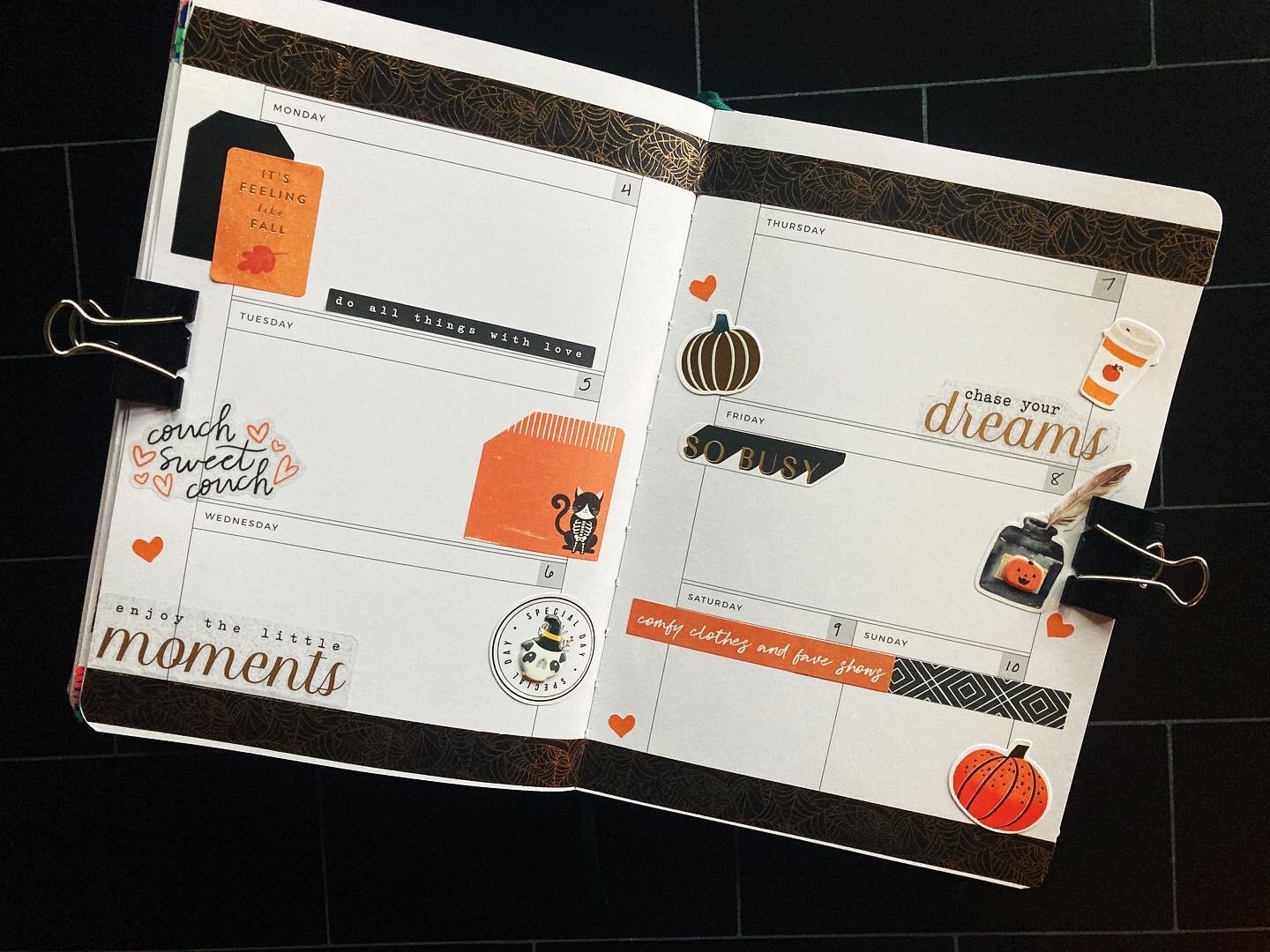
Now that the washi tape has been applied, I go through and add all the dates to the monthly page. I also begin my week on Monday. This is actually one of the biggest reasons why I started using an undated planner. A big pet peeve of mine are weekly and monthly pages that begin on Sunday. I then go page by page, adding the dates.
Since each monthly spread offers ample pages, I do find that I often have an extra weekly page at the end. Since last month ended on October 3rd, I will be starting these new pages on the 4th. I will leave the last weekly pages blank, using them as a project page for the month.
Looking at my set-up, this is always the fastest part of the process. However, I do like to luxuriate in every step. Planning, after all, is self-care. Or at least it always has been for me.
4.) Select Stickers
Now begins the biggest fun throughout this set-up, which is selecting the stickers I will use. Over the years, I have grown my collection of stickers. And I am still so in love with this craft cabinet my parents gifted me for Christmas last year, as it keeps everything organized and still has room to spare.
5.) Sticker Placement
Usually, I do go page by page, but sometimes if I see a particular sticker that I think will work on a different page, I will add it then.
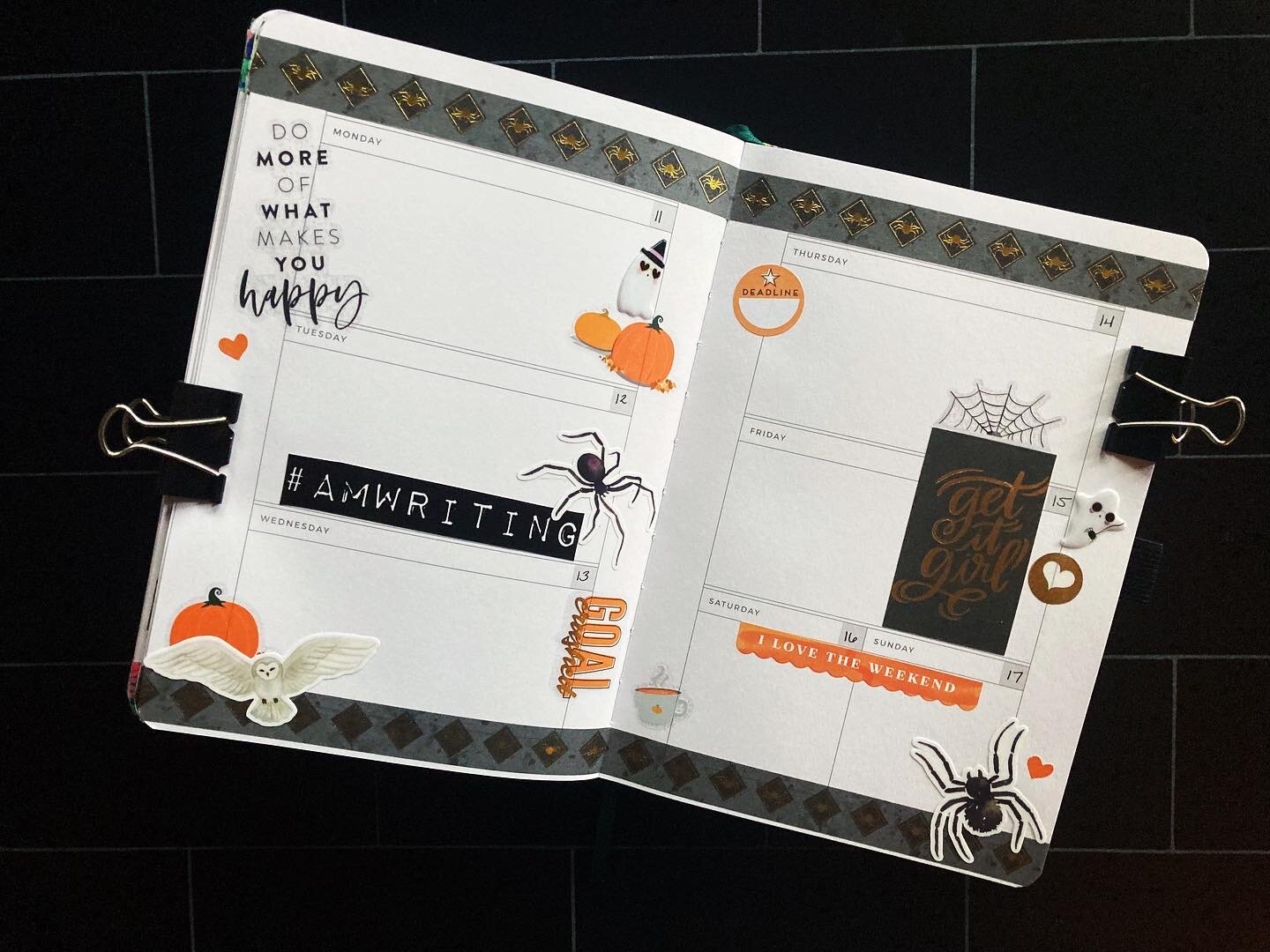
I do like to start with some of the bigger stickers and then fill in with smaller ones, usually hearts in a matching color or some other tiny detail.
Once the month is done, I move into the weeks, which allows for bigger stickers to be used. Often, I will choose stickers that correlate to an event. And when I feel a spread is done, I move on. I usually do this before a page feels too full. If I need to add a few stickers later, I will do so. But less tends to be more, and it is not difficult to go overboard.
Since I planned on using this last week as a project page, I took a thinner washi tape that has the coppery elements used in the first tape I applied, and covered the names of the week. I then added label stickers, though at this point, I wasn’t entirely sure what each section would be. However, getting close to the end, I did know I could use this to organize some dates and tasks for The Elpis Pages as I move into the next steps of that project.

The last page will be the monthly memory keeping spread. This will remain empty until the end of October, but I am planning on doing a September wrap-up soon where I walk you through this process.
6.) Spot Check

After all pages have been filled in, I go back and do a final check to see if any spaces need to be filled. This is usually the point I have my mom look through to see if there are any gaps that need to be filled in.
7.) Add Important Info
I start with the monthly calendar, adding bills due or important events that I already have scheduled. I fill in my goals for the month next, usually trying to account for what I accomplished the month before. I also try to keep these realistic. As a goal-oriented perfectionist, my old ways of goal setting was especially harmful to my mental health and I have since worked on making more manageable goals for myself.

I also add a quote for the month. Usually, this becomes a sort of mantra that I return to on the difficult days to keep myself grounded.
Next, I go week by week and add bills due, important events, and any days off I will be taking from work. It’s become a running joke since 2020 that I write in “work from home” every day. But in 10 years, I think it will be nice to see how long this continued.
8.) Add Tasks
Once these important items have been written in, I can add tasks that need to be completed that week. If I have a day where something important or noteworthy happens, I also use this space for memory keeping, but I’ll go into that during my September wrap-up.
For the final spread for October. I absolutely love the pops of color throughout and I’m even more excited for this spooky season. I can’t wait to see what October has in store for me!
Don’t forget to like and subscribe. And remember, no matter where the day takes you, dream big!
Overcoming Perfection
For as long as I can remember, I’ve struggled with perfectionism. Too many people might say this isn’t a true difficulty at all. I suspect those are the same people who are free to move from one task to the next without paying any mind to the most intricate, and possibly inconsequential, details. Such is the burden of perfection.

Amidst this latest round of edits, I have made a conscious effort to to strive for progress, rather than perfection. All the while, I’ve kept sight of May 31st; the day I will embark back into the query trenches. This solid goal has been my beacon through it all, and it looks like it is one I will accomplish. That’s not to say it’s been easy, but worthy endeavors rarely are.
Back before the MFA, and even in my third semester of graduate school, I hated editing. I always preferred the thrill of a new idea, a blank page, drafting something into completeness. But now, I think I prefer the editing process. I like the toil and the immense satisfaction that comes from taking my own words and polishing them into something better.
It's taken me time to get here. There is a sense of madness in thinking back to those early days almost 5 years ago. But I wouldn’t change any of the challenges along this journey, because it really has been a battle to get this book to where it is today; almost ready to head back into the query trenches.
There has been goodness along the way, too. There have been friends who’ve fallen in love with my fictional world, and who continue to champion Camryn and her story from near and far away. And most recently, I had the opportunity to talk with a real life agent about the first page of DREAM CATCHERS on the Manuscript Academy Podcast!
So how was I chosen to take part in this conversation?
In November 2018, I sent the first page of the manuscript to the brilliant women at The Manuscript Academy. In April 2019, I received an email wondering if I would be willing to try something new. Up until this point, the First Pages Podcast series focused on the first page of a novel being discussed for 10 minutes without the author. Though there was one episode where they later spoke with the author of said page to see how the critique might’ve helped.
For my episode, I got to chat with Danielle Chiotti in real time, just like the consultations offered on the Manuscript Academy website. And to keep the discussion as authentic as possible, the final version only cut out some of the more extemporaneous pauses, keeping the integrity of those 10 minutes.
Leading up to the recording of the podcast, I will admit I was somewhat nervous. I knew other writers might listen to this in just the same voracious manner that I experienced the other podcast episodes. But there was also the sense of knowing that I would be speaking to an industry professional, accompanied by the small fear that I would have nothing intelligent to add to our conversation.
As soon as I got on the call, however, Danielle put any worry at ease with her kind words and bright spirit. If Lorelai Gilmore was a literary agent, she would be Danielle Chiotti. Throughout our conversation, she offered some crucial feedback that has helped immensely in this last round of edits. I even got to ask a few questions at the end that have made this first page everything it needed to be. Not only did I receive real feedback, but I was also left with the hope that someone believed in this story enough to pick the first page out of the pile. Along the way, it felt like unlocking the greater potential held within this novel and my writing. And now this final draft is almost ready to send out into the agenting world in the hopes I find not only representation, but a champion for my writing career.
Now that my podcast episode has officially made its way into the world, I’ve been working on completing my plan for this latest round of edits using my Archer & Olive Daily Planner to keep everything organized. There was an extra week of blank spaces this month, and I knew I needed to put them to good use. They’ve certainly served as a reminder to keep striving for progress.

1.) Plot and Outline
For this first part of the process, I took all the notes made in the bound copy of my manuscript and added them as comments into my Scrivener document. I also added my notes from my editing spreadsheet into the Document Notes section in Scrivener. The final piece of part one was similar to how I organize my writing in the Scrivener Binder. However, instead of using those index cards, I used real ones in various colors to plot out the story. While, yes, this book was complete, and yes, it did have a finished plot outline, I knew there were some parts that could be improved. For my color coding system I used 6 colors. Yellow became scenes including character moments with family and friends. Green became discovery and forward action in the story. Purple became mythology, while pink cards were for romantic relationships. Blue became dreams and the reaming white cards were used for any new scenes that needed to be added. From there, I wrote scene by scene, laid them out in their current order, and then reshuffled until I had the best version of this story.
2.) Write New Scenes
This part of the revisions has certainly been interesting. It’s been quite some time since I’ve drafted new material for this book. However, filling in troublesome scenes mentioned by BETA readers and doing the most with the characters I already have, has been such a joy. Maybe it’s because I thrive on the challenge of creating cohesion from chaos, but either way, this portion of the process is almost complete.
3.) Line Edits
After the new material is complete, I will be going through sentence by sentence, chapter by chapter, to clean up the writing, both past and present. This might be my favorite part of the editing process, while it can be rather tedious. There is something about moving sentences to create a varied structure or finding the best word to really unlock the meaning of a sentence that is so rewarding.
4.) Read + Read + Read + Read
Long ago, I learned the importance of reading my own work aloud, especially during the editing process. However, this time, instead of just reading it through to myself, I will be recording myself on Voice Memos, chapter by chapter, and listening back as an audiobook to ensure proper pacing and to get a better idea of how the story is working as a whole. I’m looking forward to this, because I think this will give a good indication of how this story is progressing.
5.) Literary Agents
While this part of the process is already half done, there is still a little bit of work to finish. Since I began the query process, I have had the agents I wanted to send my work to sorted into groups to assist with easier batches. I have the research for those agents already saved in a miscellaneous file. But, it’s been quite some time since I’ve updated the list. And in that time, there have been new agents entering into the literary world, recent additions to #MSWL YA on Twitter, and a better understanding of what I am looking for in an agent. All of that combined means I’ll need to do a bit more research before I begin the next round of queries. Along with organizing agent info in Scrivener, as previously discussed in a past post, I will also be organizing my “Agent Questions” document I have for hope that when I get “the call” from an agent, I will have everything I need.
6.) Query Materials
Once the edits are done, I will need to proofread the query (AGAIN) and update my synopsis. Next will be looking at my agent list to ensure I’m following their specific submission guidelines and that all materials are handled properly and included for QUERY DAY!
7.) Finish Line
I’m also calling this QUERY DAY, knowing that May 31st is quickly approaching. I will send out my query and materials to the agents and will then update my spreadsheet and information in Scrivener, possibly update Query Tracker, though I haven’t been as impressed with its capabilities in conjunction with my own tracking method. And then, dear reader, I will wait.
Until then, I know there might be a few more difficult days, maybe some where the writing and revision and editing all seems unmanageable. However, knowing that I'm not going in to make DREAM CATCHERS perfect, but rather, the best story it can be, will continue to help me make this dream of publication a reality.
Sure there has been rejection along the way, and this book has not always been easy to write. Too often, as writers, we find ourselves on the page without even trying, and that makes writing the hard scenes even more difficult. But it also makes them more rewarding. I love Camryn, and I believe her story is one that deserves to be told. At the end of the day, I think that's the best we get as writers. We break ourselves a little each time we put words on the page, but I've found that edits heal me a little bit, too.
Whether you’re a writer in the midst of edits and queries or just someone with their own set of struggles, I hope you, too, will take comfort in knowing that progress beats perfection any day.
Out of the Spiral
Writing has and always will be my haven. Even on the difficult days. Maybe, most especially on those days, I escape into words. I spoke about this notion of retreat with a friend and fellow writer from the MFA. In emailing back and forth with her, I wrote: Success is relative. Perseverance is everything. And in articulating that sentiment in real words, I was able to find strength in my struggle and healing in my hard work.

So what do I mean when I say words are my retreat?
For this to make better sense, I suppose I must admit just how difficult the month of February has always been for me. I don’t think I realized this until diving into my journal archives and discovering a pattern of exhaustion and struggle; all within the month of February. This year was much the same, with the added flare up of anxiety that was all at once consuming and vicious. I always tend to retreat into myself and become insular when my anxious thoughts take over. And usually, writing is the only thing to pull me out of the perpetual spiral of spinning thoughts and racing pulse.
But this year, I couldn’t write the words I needed to find my way out of the spiral, and this, too, was terrifying and contributed further to the sense that I was not only struggling, but failing. It was a sting far worse than any rejection I’ve ever received because it was was self-actualized. The more I felt I was failing: at work and in my writing and in communicating with the people I appreciate most, the more I felt weak and waning and weathered.
Fast forward to a much needed trip to New York City to visit with one of the best friends. I didn’t take my computer. The journal I had abandoned at the end of January continued to collect dust on my desk. I brought two books, one which I had so loved in the past, and in that memory, felt safe. I arrived to an empty apartment in Astoria and slept for three hours. I walked through a neighborhood I’d yet to explore, finding food, and quiet. I let my mind go without thinking and list-making and bullying for the act of just existing. I ate and showered and read some more and prepared to see Alice By Heart, a reimagining of Alice’s Adventures in Wonderland. I spoke of some of my anxiety with the best friend and texted with the other. Throughout the weekend, I found my way back to my favorite places that still feel a little like home. I finished that book, connecting with it even more the second time around, and I bought more books. All the while, I knew the real work would begin once I was back home.
I would find my way out of the spiral. I would put myself back together. I would be kinder to myself. I would be better.
These were all promises I made with myself from a beach in Astoria beside the best friend as we drank Shamrock shakes and watched night take over. And when I returned home, I got to work. I ordered a new planner from Archer & Olive. I found an unfinished journal that was nothing like the ones I’d used since the MFA. I read a graphic novel, and then another. I started taking melatonin on nights where I knew sleep would be evasive. I apologized to myself, and started practicing self-kindness.
So how did I make these promises into realistic goals I could accomplish?
1.) New Planner
I've kept a steady journal since my undergrad in 2012, though they have evolved since then. I was strictly using a black hardbound square grid Moleskine journal. It became a rather superstitious thing for me. And up until February, I used to set up my monthly calendar, monthly goals, and weekly to do lists within the journal along with whatever I had been writing.
Unfortunately, however, I found myself getting days or weeks behind, which is right around the time my anxiety started to intensify. I think it was initially triggered at work, which held its own set of challenges, and trickled down through my writing life. But I purchased the Archer & Olive Daily Agenda, which comes blank. I have since fallen in love with it. I do my monthly set ups at the beginning of each month (mainly because I use a new pen color so I don't set it up any earlier than that) and I fill in my baseline weekly spreads at that point, too. I write my to do tasks on a week to week basis from there, using a new quote, stickers, and correlating washi tape just to add some creative flair to planning my week.

I think the biggest reason my process NEEDED to change was that I had stopped enjoying/utilizing the old way of planning in my journal. I realized I wasn't using it for journaling and writing as much as I had in the past, which was problematic. I was beating myself up day after day for not keeping up with it, and eventually hit my breaking point.
Since switching to this new planner, I’ve worked on a facet of my anxiety that truly was the most concerning. I was making lists. And not the usual to do list. I was making lists of things I needed to make lists for and nothing was being accomplished, but rather listed the next day and the day after that and I felt myself slipping away from progress. This is not to say that a planner cured my anxiety. But by recognizing a symptom of this spiral and working to get it under control, I was able to be more mindful and realistic about my weekly and monthly goals.
2.) Bedtime Habits
As someone who used to be a night owl, my bedtime habits have been a struggle to balance with my full-time job. Upon returning well-rested from my trip to NYC, I knew I needed to make some changes to my nighttime routine, including taking melatonin on nights when sleep seemed too far away. And this has helped. I’ve also been better about being on my computer or phone before bed, exchanging technology for reading, and it has helped immensely.
3.) Self-Kindness
This might be the biggest factor that has helped throughout the month of March, making me feel ready to conquer the rest of 2019. I am only one person. There are only so many hours in the day. I can only accomplish so much, and that is not everything. This is something I’ve focused on throughout the past month. I get through as much writing and editing and research after work until I can’t anymore. Instead of bullying myself into working past the point of exhaustion or feeling guilty for the work I haven’t done, I instead tell myself there might be more work, but there is also another day tomorrow. That’s not to say I’m giving up or procrastinating, but rather, giving myself days to recover and recharge and refill the creative well before getting back into the edits or prepping for the query trenches. It’s all about balance, and this is something I still struggle to find. But I’m trying. And for that, I am so proud.
So what does this have to do with the idea of success and perseverance?
In many ways, this year has been kind to me. I’ve had several pieces published and accepted. But I also have 61 rejections for just three months into the new year, which is where the idea that Success is relative. Perseverance is everything seems more true than anything else. Poems that have been rejected too many times in the past are finding homes, and I am still seeking representation for DREAM CATCHERS. I am back to editing the manuscript to prepare for the query trenches, and exciting things are happening soon. Though I can’t discuss them just yet, know that good news is coming! To keep up with future blog posts, the secret announcement, and what’s being published next, check in with my NEWS!
Now that I’ve found my way out of the spiral for the time being, there is still the sense that I will be trapped in that bad place again. It’s a fear, but one I’m managing. And this is not usually something I discuss, because as I’ve said, I become insular and retreat into myself and my writing. But with celebrating my successes and posting my publications, I felt there needed to be some transparency.
Too often I find myself sharing only the publication news, and maybe that does my readers a disservice. I personally don't dwell too much on rejections, and so don't often talk about them. Not because they're taboo, but I just assume everyone gets tired of listening to writers talk about rejection. But I want you, dear reader, to know that success, however you define it, comes from hard work and struggle and perseverance.
The life of the writer is just as messy as any other. But I’m trying, and I think that’s all we can do. I hope you’ll try, too!
